
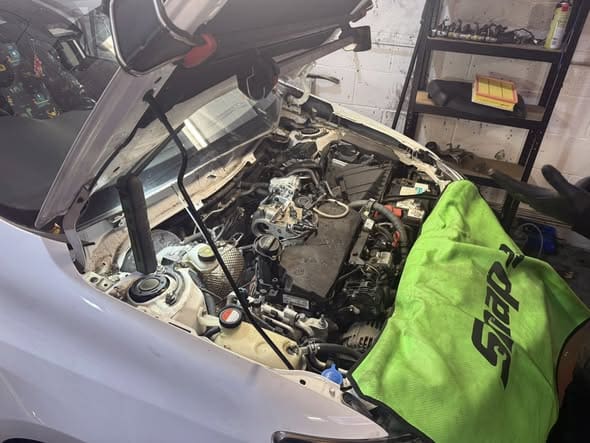
Timing chain issues on BMW N47 engines are well known.
What changes from car to car is how early the problem is caught.
This 2015 BMW 320d arrived after the window for early intervention had already closed.
The engine had lost compression.
The chain had failed.
Internal damage was already done.
At that point, the decision was no longer about replacing a chain.
It was about whether the engine could be rebuilt properly.
This post walks through what failed, what damage we found, and how a full rebuild brought the car back from what many would write off.
The initial diagnosis
The BMW came in with a suspected timing chain failure.
There was no compression.
That single fact tells you a lot.
Loss of compression points to valve and piston interaction.
At that stage, starting the engine is no longer an option.
Testing becomes visual and mechanical.
Once initial checks confirmed the severity, it was clear the engine had to come out.
There is no shortcut once internal timing damage is suspected.
This type of work falls under our
engine removal and engine work
service.
You cannot assess or repair damage like this with the engine still in the car.
Removing the engine and stripping it down
With the engine removed, the full extent of the failure became visible.
The timing chain had snapped.
Guides were broken.
Gears were damaged.
Pieces of chain were scattered throughout the casing.
This is the point where many engines are written off.
But writing an engine off without assessing the core components is a mistake.
The cylinder head was removed to assess valve and piston damage.
The findings were serious, but not terminal.
Assessing the internal damage
Once stripped, the damage could be measured properly.
- Valve contact marks were visible on the piston tops.
- Several valves were bent.
- The timing chain and guides were destroyed.
- The block itself was in good condition.
- The pistons showed no cracking or structural failure.
This assessment matters.
A damaged head does not automatically mean a damaged block.
Knowing where the damage stops saves engines.
With the block and pistons confirmed usable, a rebuild became viable.
The rebuild plan
Once the decision to rebuild was made, the job became about detail.
Engine rebuilds succeed or fail on preparation.
The plan included:
- Full timing chain replacement.
- Replacement of damaged valves.
- Inspection and testing of the cylinder head.
- Replacement of worn or damaged internal components.
- Correct reassembly with proper torque and timing procedures.
This is not a parts-swap exercise.
It is precision work.
Parts sourcing and specialist support
The parts list for this rebuild was extensive.
Using the wrong components at this stage would undo all the work.
A big thank you goes to Richard Smith at PCS, who sourced the required parts.
This included genuine BMW components, even collecting parts directly where needed.
Cylinder head testing and skimming was carried out by Vinny Lawson.
The head was checked properly before being rebuilt.
In total:
- 8 exhaust valves were replaced.
- 2 inlet valves were replaced.
- The head was prepared for reassembly.
This level of care is the difference between an engine that lasts and one that fails again.
Why N47 timing chains fail so destructively
The BMW N47 engine is known for timing chain issues.
When failure occurs, it is rarely gentle.
Common contributing factors include:
- Chain stretch over time.
- Guide wear.
- Oil quality and extended service intervals.
- High mileage without early intervention.
Early symptoms are often ignored.
Rattles.
Fault codes.
Cold start noise.
When the chain finally lets go, the engine does not get a second chance.
This is why we always advise early checks through our
timing chains and belts
service rather than waiting for failure.
Reassembly and first start
With the head rebuilt and the bottom end confirmed sound, reassembly began.
Every step followed the correct sequence.
Timing set accurately.
Torque values followed exactly.
This stage leaves no room for shortcuts.
One missed step can undo weeks of work.
Friday afternoon, the engine took its first breath after the rebuild.
Oil pressure built correctly.
Compression restored.
No abnormal noise.
The engine was allowed to settle before final checks.
Monitoring matters as much as the build itself.
Final checks and road testing
Before returning the car to the customer, final checks were completed.
- Fluid levels checked.
- Diagnostic scans completed.
- Live data reviewed.
- Road testing carried out.
Dealer-level diagnostic software allows us to confirm everything is communicating correctly.
Coding and adaptations are verified where required.
This is where our
car diagnostics
service supports mechanical work.
Modern engines demand both.
Experience matters with N47 rebuilds
This was not a first.
“The Doctor” has now completed multiple N47 rebuilds.
Patterns repeat.
Knowing where engines fail saves time and mistakes.
Experience also helps decide when a rebuild makes sense.
Not every engine is a candidate.
This one was.
The result was an engine running smoothly again, ready to return to the customer after final checks.
When is a rebuild the right option
An engine rebuild may be the right choice if:
- The block and pistons are undamaged.
- The vehicle is otherwise in good condition.
- Replacement engines carry unknown history.
- You want to keep the car long-term.
Rebuilds are not cheap.
Neither are unknown engines.
The right choice depends on facts, not fear.
Get timing issues checked early
This BMW could have avoided a rebuild if the timing chain issue was caught earlier.
That is the hard truth.
Rattles, warning lights, and correlation faults are not normal.
They are warnings.
If you drive a BMW diesel and notice early signs, act.
Start with a proper inspection through our
contact page.
Catching timing issues early saves engines.
Leaving them turns repairs into rebuilds.
Need this looked at?
Describe the symptom and we’ll tell you whether it needs a diagnostic slot or a straight booking.
- 5.0 from 235 Google reviews
- Mon–Fri 08:30–18:00
- 2 Warsop Road, Mansfield Woodhouse