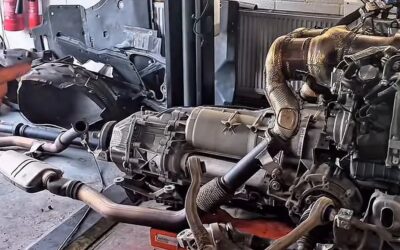

Most engine faults on the Jaguar and Land Rover Ingenium 2.0 diesel give you some kind of warning. A rattle on cold start. A warning light. A drop in performance. This one does not.
Related reading: see a real Jaguar Ingenium 2.0 timing chain replacement case study.
When coolant leaks from the thermostat housing and drips onto the piston cooling oil jet solenoid below it, the engine management system usually stays quiet. No warning light comes on. No limp mode. No obvious symptom at all — at least not early on. Meanwhile, the pistons are running hotter than they were designed to, and the damage is already starting to build.
We see this fault regularly at Star Garage Mansfield. It is one of the most important things to catch early on any Ingenium engine, because the cost difference between finding it in time and missing it is enormous. Caught early, it is a straightforward fix. Left too long, it leads to piston ring wear and eventually a full engine rebuild.
Contents
- What the piston cooling oil jet solenoid actually does
- How a thermostat housing leak triggers the fault
- Why no warning light comes on
- What happens inside the engine when the solenoid fails
- Symptoms to watch for
- The P25A9 fault code explained
- Which Jaguar and Land Rover models are affected
- What the repair involves
- What happens if it is missed
- What to do next
What the piston cooling oil jet solenoid actually does
Inside the Ingenium 2.0 diesel engine, there are small oil jets positioned to spray engine oil at the underside of each piston. These are called piston cooling oil jets, and their job is to keep piston temperatures within safe limits — particularly under load, when the combustion process generates serious heat.
The piston cooling oil jet solenoid is an electronically controlled valve that regulates when and how those jets operate. The ECU manages it based on engine load, temperature, and operating conditions. When everything is working correctly, the pistons are cooled precisely and the engine runs within its designed temperature tolerances.
When the solenoid fails, that control is lost. The ECU can no longer manage piston cooling accurately. The jets may not operate when they should — and the pistons run hotter than they were designed to as a result.
How a thermostat housing leak triggers the fault
The thermostat housing gasket on the Ingenium 2.0 is a known weak point. When it starts to fail, coolant begins to seep out — often slowly at first, in a way that does not produce a visible puddle under the car or a dramatic drop in the coolant reservoir.
The problem is where that coolant goes. Because the solenoid sits directly below the thermostat housing on the left side of the cylinder block, leaking coolant tracks down the block and drips onto the solenoid body and its electrical connector. Over time, the coolant shorts the connector, corrodes the terminals, and damages the solenoid internally.
Once that damage occurs, the solenoid cannot operate reliably. The piston cooling function it controls is compromised — and the engine has no reliable way of telling the driver that anything is wrong.
How the failure chain works
- Thermostat housing gasket begins to fail
- Coolant seeps out slowly — often no visible puddle
- Coolant tracks down the block onto the solenoid below
- Solenoid connector shorts and corrodes
- Solenoid loses reliable function
- ECU loses control of piston cooling
- Pistons run hotter than designed, undetected
Why the location makes it worse
- Solenoid sits directly beneath the thermostat housing
- Coolant naturally tracks onto it as it leaks
- No external puddle to alert the driver
- Coolant loss can be slow enough to go unnoticed
- By the time symptoms appear, solenoid damage is done
Why no warning light comes on
This is the detail that makes this fault genuinely dangerous. On most engine problems, the ECU detects something outside its expected parameters and triggers a warning. Timing chain faults produce rattles and eventually fault codes. Turbo issues trigger limp mode. DPF problems light up the dashboard.
The piston cooling solenoid fault does not work that way. The ECU may log a code — often P25A9 — but this does not always trigger the engine management light in the way drivers expect. In many cases the car simply continues to run, apparently normally, while the piston cooling system is not functioning as it should.
The owner has no prompt to investigate. The engine feels fine. And underneath, the pistons are running at temperatures that slowly cause premature wear on the piston rings and cylinder walls — damage that only becomes apparent later, when it has already progressed significantly.
What happens inside the engine when the solenoid fails
Piston cooling exists for a reason. Diesel combustion generates intense localised heat, and the pistons absorb a significant amount of it. The oil jets underneath them are part of how the engine manages that heat within safe limits. Remove that cooling function, and the pistons run hotter than the engine was designed to allow.
Sustained elevated piston temperatures cause accelerated wear on the piston rings — the components that seal each cylinder and control oil consumption. As the rings wear prematurely, they begin to lose their ability to seal the cylinder correctly. Combustion gases start to pass the rings into the crankcase. Oil begins to enter the combustion chamber.
This progression — piston ring wear, blow-by, oil consumption, loss of compression — is what ultimately leads to an engine that needs a full rebuild. And because the process happens gradually and silently, many owners only become aware of it once the engine is already using oil, smoking, or losing power noticeably.
| Stage | What is happening | What the driver notices |
|---|---|---|
| Early | Solenoid compromised, piston cooling reduced | Usually nothing — or unexplained coolant loss |
| Developing | Pistons running hot, ring wear beginning | Possibly P25A9 code, no EML in most cases |
| Progressed | Piston ring wear established, blow-by increasing | Oil consumption, slight blue smoke at startup |
| Advanced | Significant ring and bore wear, compression loss | Power loss, heavy oil consumption, smoke, engine noise |
| End stage | Engine requires full rebuild or replacement | Major failure — engine no longer viable as-is |
Symptoms to watch for
Because this fault progresses quietly, the symptoms to watch for are subtle — at least early on. By the time the obvious signs appear, the damage is usually already at an advanced stage. The most important thing owners can do is act on the early indicators rather than waiting for something dramatic to happen.
Early warning signs
- Unexplained coolant loss with no visible external leak
- Coolant reservoir dropping slowly over weeks
- P25A9 fault code — even without an engine management light
- “Critically Low Oil” warning message when oil level is actually normal
- Faint coolant smell from the engine bay
Later stage symptoms
- Increasing oil consumption between services
- Blue-tinged smoke from the exhaust, especially on startup
- Loss of power or rough running
- Higher fuel consumption than usual
- Engine noise as internal wear progresses
If you own an Ingenium 2.0 diesel and notice unexplained coolant loss — even a small amount — it is worth having the thermostat housing area inspected specifically. Do not assume it is a minor issue that can wait.
The P25A9 fault code explained
P25A9 is the fault code associated with the piston cooling oil jet solenoid circuit on the Ingenium 2.0 engine. It relates to a problem detected in the solenoid’s electrical circuit — which is exactly what coolant damage to the connector causes.
The code sometimes presents alongside a “Critically Low Oil” warning message on the dashboard, even when the oil level is perfectly normal. This is because the solenoid’s malfunction is being misread by the system in a way that produces a misleading oil-related alert. Many drivers and general garages see that message, check the oil, find it fine, clear the code and move on — without investigating what actually triggered it.
That response misses the point entirely. P25A9 on an Ingenium 2.0 should prompt an immediate inspection of the thermostat housing area and the solenoid below it. The code is telling you something real — it is just not telling you in the most obvious way.
Which Jaguar and Land Rover models are affected
This fault affects any vehicle fitted with the Ingenium 2.0 diesel engine — sold under the engine codes AJ200D, 204DTD or 204D4. That covers a wide range of Jaguar and Land Rover models built from 2015 onwards.
Jaguar models
- Jaguar XE (2015–present)
- Jaguar XF X260 (2015–present)
- Jaguar E-PACE (2017–present)
- Jaguar F-PACE (2016–present)
Land Rover models
- Land Rover Discovery Sport (2015–present)
- Range Rover Evoque L538 (2015–2018)
- Range Rover Evoque L551 (2019–present)
- Range Rover Velar (2017–present)
- Land Rover Discovery 5 (2017–present)
- Land Rover Defender L663 (2020–present)
Pre-2019 vehicles are generally considered more susceptible, but the fault is not limited to older examples. Any Ingenium 2.0 diesel with a failing thermostat housing gasket is at risk regardless of year.
What the repair involves
When caught early — before piston ring wear has developed — this is a manageable repair. The work involves replacing the thermostat housing gasket to stop the source of the leak, and replacing the piston cooling oil jet solenoid and its connector, which will have been damaged by coolant contact.
Simply replacing the solenoid without addressing the thermostat housing leak that caused it is not enough. If the leak is still present, a new solenoid will be damaged again in the same way. Both parts of the repair need to be done together.
At Star Garage Mansfield, we start with a full inspection and diagnostic check to confirm the extent of the damage before recommending the repair route. If piston ring wear has already developed, the assessment will make that clear and we will discuss the realistic options with you honestly.
| Repair stage | What is done | Approximate cost |
|---|---|---|
| Caught early | Thermostat housing gasket + solenoid replacement | Priced on inspection |
| Progressed — piston ring wear | Above plus internal engine assessment and repair | Varies significantly |
| Advanced — end stage | Full engine rebuild or replacement | Priced after strip-down |
The cost difference between an early repair and an end-stage rebuild is the clearest argument for investigating quickly. A gasket and solenoid job caught early is a very different situation to a full engine rebuild that could have been avoided.
What happens if it is missed
This is the honest part of the conversation that owners deserve to hear clearly. If the piston cooling solenoid fault goes undetected and unrepaired for long enough, the engine will need a full rebuild. There is no partial version of that outcome once the damage has progressed past a certain point.
A full Ingenium engine rebuild involves replacing pistons, rings, bearings, the timing chain kit, the oil pump, and reconditioning the cylinder head. It is a major job, and it is expensive. And critically — it is largely avoidable when the fault that causes it is caught at the early, cheap stage.
That is what makes this fault worth understanding. It is not a rare or obscure problem. It is a known failure on a very common engine, it progresses silently, and the cost curve between catching it early and catching it late is steep.
What to do next
If your Jaguar or Land Rover Ingenium 2.0 diesel is showing unexplained coolant loss, a P25A9 code, a misleading “Critically Low Oil” warning, or any of the early symptoms described above, do not wait for something more obvious to develop.
At Star Garage Mansfield we specialise in Ingenium 2.0 diesel engine faults and diagnose this specific issue regularly. We will inspect the thermostat housing area, assess the solenoid and connector, check for any signs of developing piston ring wear, and give you an honest picture of where the engine actually stands.
We work with Jaguar XE, XF, E-PACE, F-PACE, Discovery Sport, Range Rover Evoque, Velar, and Defender owners across Mansfield, Mansfield Woodhouse, and the surrounding area. If you are not sure whether this applies to your vehicle, call us and describe what you are seeing — we will tell you whether it warrants investigation.
You can also read about the timing chain problems that affect the same engine, or visit our contact page to book an inspection.
Suspect a piston cooling solenoid fault on your Ingenium?
Don’t wait for a warning light that may never come. If your Jaguar or Land Rover is losing coolant, showing P25A9, or something just doesn’t feel right — book an inspection now. Early diagnosis is the difference between a small repair and a full engine rebuild.
Star Garage Mansfield · 2 Warsop Road, Mansfield Woodhouse, Mansfield NG19 9LF · 01623 904724
Frequently asked questions
What is the piston cooling oil jet solenoid on the Ingenium 2.0?
It is an electronically controlled valve that regulates oil jets spraying cooling oil at the underside of the pistons. When it fails, the ECU loses accurate control of piston temperature and the pistons run hotter than designed.
Why does a thermostat housing leak cause the solenoid to fail?
The solenoid sits directly below the thermostat housing on the left side of the cylinder block. When the thermostat housing gasket fails, coolant drips straight onto the solenoid body and electrical connector, shorting and corroding it.
Will my engine management light come on if this fault develops?
Not always — and that is what makes this fault particularly dangerous. In many cases the car continues to run apparently normally while the piston cooling system is compromised. The absence of a warning light does not mean there is no problem.
What does the P25A9 fault code mean on a Jaguar or Land Rover?
P25A9 relates to a fault in the piston cooling oil jet solenoid circuit. It sometimes presents alongside a misleading “Critically Low Oil” warning even when oil level is normal. It should always prompt a full inspection of the thermostat housing area and solenoid.
How much does it cost to fix if caught early?
A thermostat housing gasket and solenoid replacement is a comparatively modest job when caught before any piston ring wear has developed, and we price it once we have seen the car. If the fault is left and internal wear progresses, costs rise significantly, and a full engine rebuild is a different order of expense altogether.
Which Jaguar and Land Rover models are affected?
Any vehicle fitted with the Ingenium 2.0 diesel (AJ200D / 204DTD) from 2015 onwards — including the Jaguar XE, XF, E-PACE, F-PACE, Land Rover Discovery Sport, Range Rover Evoque, Range Rover Velar, Discovery 5 and Defender L663.
Can I keep driving if I suspect this fault?
We would not recommend it without having the vehicle inspected first. If coolant is leaking onto the solenoid and piston cooling is compromised, continued driving accelerates the internal damage. Book an inspection as soon as possible.
Need this looked at?
Describe the symptom and we’ll tell you whether it needs a diagnostic slot or a straight booking.
- 5.0 from 235 Google reviews
- Mon–Fri 08:30–18:00
- 2 Warsop Road, Mansfield Woodhouse