A cambelt failure is one of the most serious mechanical events that can happen to a car engine. Unlike many faults, it often arrives without warning — but there are signs that can indicate the belt is nearing the end of its life or developing a problem. This guide explains what to look for, when to act, and why not replacing a cambelt on time is one of the most costly mistakes a driver can make.
Quick Answer

Contents
What Does a Cambelt Do — and Why Does It Matter?
The cambelt — also called a timing belt — connects the crankshaft to the camshaft or camshafts, keeping the valves and pistons in precise synchronisation. On every engine cycle, the crankshaft rotates twice for every one rotation of the camshaft. The belt maintains this exact ratio.
In an interference engine — which includes the majority of modern petrol and diesel cars — the valves and pistons occupy the same space at different moments in the combustion cycle. The cambelt is what prevents them from ever being in that space at the same time. If the belt slips, jumps, or breaks, this relationship is lost immediately.

Cambelt Failure Symptoms: What to Look and Listen For
Cambelt failure is not always preceded by obvious symptoms. The belt can appear healthy right until the moment it fails. That said, these warning signs should always be investigated promptly.
Rough Running or Misfiring
As a cambelt ages, it can stretch slightly or begin to wear on its teeth. When this happens, cam timing drifts. The engine management system may compensate for a period, but eventually the engine will run rough at idle, hesitate under load, or develop intermittent misfires. This is particularly common on high-mileage cars approaching or past their replacement interval.
Ticking or Slapping Noise from the Engine
A worn cambelt can produce a ticking, slapping, or rhythmic knocking noise as it contacts the timing cover or as the belt tensioner pulley deteriorates. This is different from a valve train tick and tends to track with engine speed rather than staying constant. Any unusual noise from the front of the engine on a car with a cambelt should be investigated.
Check Engine Light and Timing-Related Fault Codes
If the belt stretches enough for cam-crank correlation to fall outside tolerance, the engine management system will flag this with a fault code — typically P0016 or P0341. These codes do not always mean the belt has failed yet, but they are a strong signal that timing accuracy has been compromised and inspection is urgent.
Engine Refuses to Start
If a cambelt has already jumped teeth on the sprocket, the engine may refuse to start, or start and immediately cut out. If a car that was running normally suddenly fails to start with no clear explanation, a jumped or broken cambelt should be among the first things checked — particularly if the car is at or past its replacement interval.
Loss of Power Under Load
A belt that has partly jumped or is running with incorrect tension causes timing deviation that directly affects engine output. The car may feel sluggish, unwilling to rev, or may enter a reduced-power mode. This can be mistaken for a fuelling or turbo problem before the cambelt is checked.
Visible Warning Signs of a Worn Cambelt
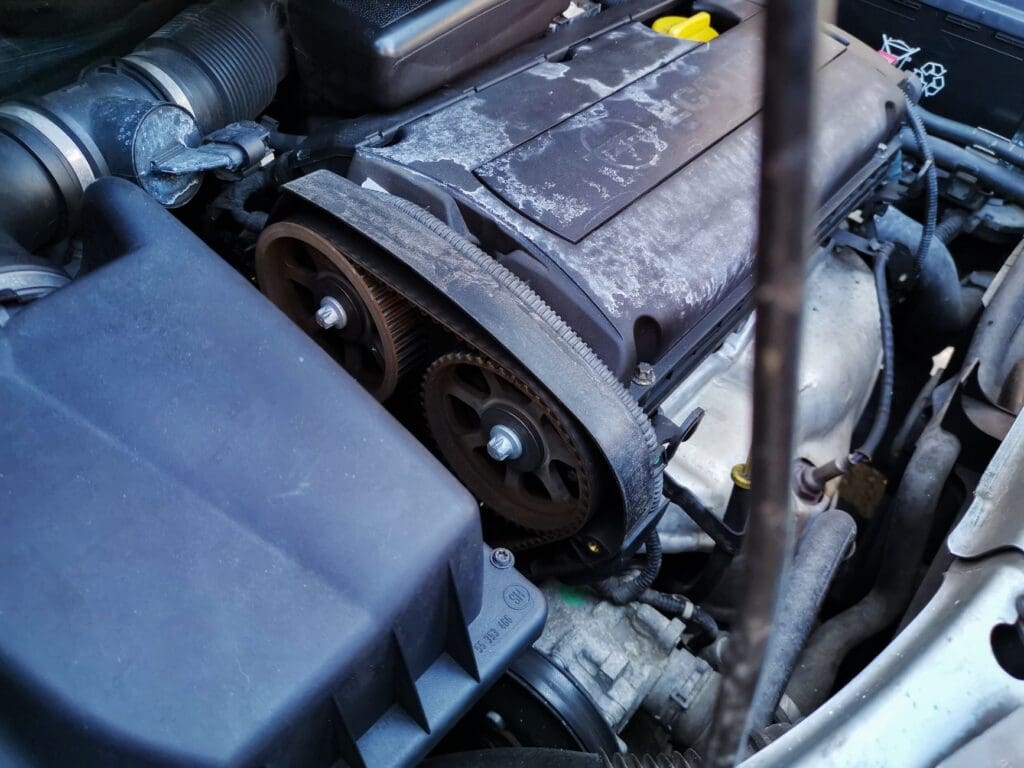
In some cases, signs of cambelt wear can be identified before failure occurs — though this usually requires the cambelt cover to be removed for inspection.
- Cracking or glazing — As rubber ages, it dries and develops fine surface cracks. A glazed, shiny appearance also indicates the belt has hardened and lost flexibility.
- Missing or worn teeth — The belt drives the camshaft via a toothed interface. Worn, cracked, or missing teeth indicate advanced deterioration.
- Fraying edges — A belt that has been running with misaligned pulleys may show fraying on one or both edges.
- Oil or coolant contamination — Oil from a leaking cam seal, or coolant from a weeping water pump, can saturate and rapidly degrade a cambelt. Contaminated belts should be replaced immediately, regardless of mileage.
- Tensioner pulley bearing noise — The belt tensioner and idler pulleys should spin freely and silently. If they are noisy or rough when spun by hand, they need replacing alongside the belt.
What Happens When a Cambelt Snaps?
The sequence of events when a cambelt breaks on an interference engine is fast, mechanical, and expensive.
- Belt breaks or jumps — The connection between crankshaft and camshaft is lost. The camshaft stops rotating, but the crankshaft continues for a brief moment under the momentum of the drivetrain.
- Valves stay open — With the camshaft stopped, some valves remain in the open position.
- Piston contact — The still-rotating crankshaft drives the pistons upward. An open valve in the combustion chamber is struck by the rising piston crown.
- Valve damage — The impact bends the valve, typically snapping or deforming the stem. Multiple valves may be damaged in a single failure event.
- Secondary damage — Bent valve stems can damage valve seats, valve guides, and in severe cases, crack the cylinder head. Broken valve material can enter the cylinder and cause piston or bore damage.
In best-case scenarios, the repair involves replacing bent valves and a head skim — costs typically starting priced on inspection depending on the extent of damage. In worst-case scenarios, the cylinder head is beyond economic repair, or the engine requires full replacement.
None of this is inevitable. It is entirely preventable with a cambelt replacement carried out on schedule.
When Should You Replace Your Cambelt?
Every manufacturer specifies a replacement interval for the cambelt. This is typically expressed as a mileage interval, a time interval (in years), or both — and the rule is to follow whichever comes first.
| Manufacturer | Typical Interval |
|---|---|
| Ford (1.0 EcoBoost, 1.5 TDCi) | 10 years or 125,000 miles |
| Volkswagen / Audi (TDI diesel) | 5 years or 75,000 miles (check model-specific) |
| Renault (1.5 dCi, 1.6 dCi) | 5 years or 72,000–96,000 miles |
| Peugeot / Citroën (1.6 HDI) | 5 years or 72,000 miles |
| Toyota (petrol models) | Most use chains; check engine code |
| BMW (N series petrol) | Most use chains; some early models use belt |
If a car is purchased second-hand and the cambelt history is unknown or undocumented, replacement should be treated as overdue and scheduled promptly.
Cambelt Replacement Cost UK
Cambelt replacement cost varies depending on engine complexity, whether a water pump is included, and whether you use a main dealer or independent specialist.
| Vehicle Type | Typical Independent Cost | Includes |
|---|---|---|
| Small petrol (1.0–1.2) | Priced per vehicle | Belt, tensioner, idler |
| Medium petrol or diesel (1.4–1.6) | Priced per vehicle | Belt, tensioner, idler, water pump |
| Larger engine or complex layout | Priced per vehicle | Full cambelt kit, water pump, gaskets |
| Performance or specialist engine | Priced per vehicle | Varies by engine |
The water pump is driven by the cambelt on many engines. Replacing it at the same time as the belt adds relatively little to the labour cost, but prevents having to strip the same components again if the pump fails between services. We always recommend including the water pump unless it has recently been replaced.
At Star Garage Mansfield, we carry out cambelt replacements across a wide range of petrol and diesel engines. We use OEM-quality or genuine parts, confirm timing accuracy post-installation, and provide a written job card detailing exactly what was done. Visit our timing chain and belt service page for more details.
Due a Cambelt or Unsure of Its History?
Don’t take a risk with your engine. Star Garage Mansfield can check your service history, confirm belt condition, and carry out a full cambelt and water pump replacement at a fair price. Book in today.
Call 01623 904724 — Star Garage Mansfield, 2 Warsop Road, NG19 9LF
Frequently Asked Questions
Does my car have a cambelt or a timing chain?
This depends on the engine. Many petrol engines below 2.0 litres use a cambelt. Most modern diesel engines now use a chain, though older diesels commonly have belts. You can find out by checking your service booklet, looking up your engine code online, or asking us when you book in.
Can a cambelt fail before the recommended replacement interval?
Yes. Oil contamination, coolant leaks, or tensioner failure can cause premature belt failure regardless of mileage. If any of these issues are present, the belt should be inspected immediately rather than waiting for the scheduled interval.
Is it safe to drive a car that is overdue a cambelt change?
Not advisably. Every mile over the recommended interval increases the risk of failure. If your car is overdue, book the replacement as soon as possible and avoid long journeys or high-rev driving in the meantime.
How long does a cambelt replacement take?
On most common engines, a cambelt and water pump replacement takes three to five hours. The car is generally available the same day.
What is the difference between a cambelt and a timing belt?
None — they are the same component. The terms are used interchangeably in the UK. The belt that drives the camshaft is called both a cambelt and a timing belt depending on the context and the person describing it.
Need this looked at?
Describe the symptom and we’ll tell you whether it needs a diagnostic slot or a straight booking.
- 5.0 from 235 Google reviews
- Mon–Fri 08:30–18:00
- 2 Warsop Road, Mansfield Woodhouse