Suspension problems rarely appear all at once. Most start as minor niggles — a slight knock, a pull, a wobble — before gradually worsening into something that affects safety and handling. Catching suspension fault symptoms early saves money and, in serious cases, prevents a loss of control on the road.
Contents
What Your Suspension Actually Does
Your car’s suspension system has two primary jobs: to keep the tyres in contact with the road at all times, and to absorb the shocks and vibrations that come from driving over imperfect surfaces. Without it, every bump would be transmitted directly into the cabin, and more critically, the wheels would lose grip through corners and braking.
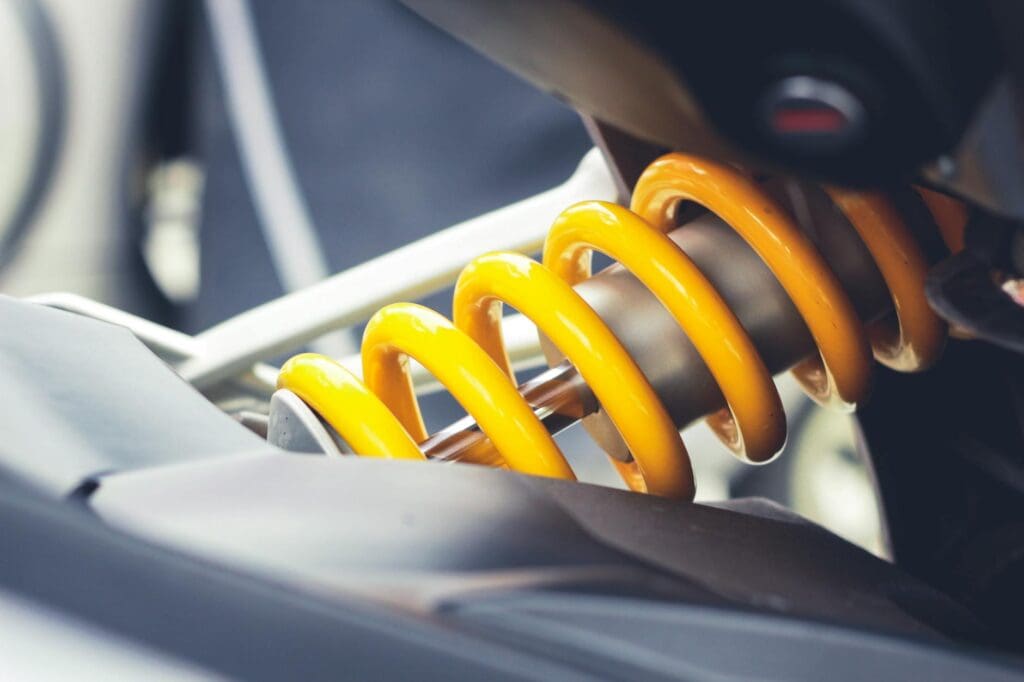
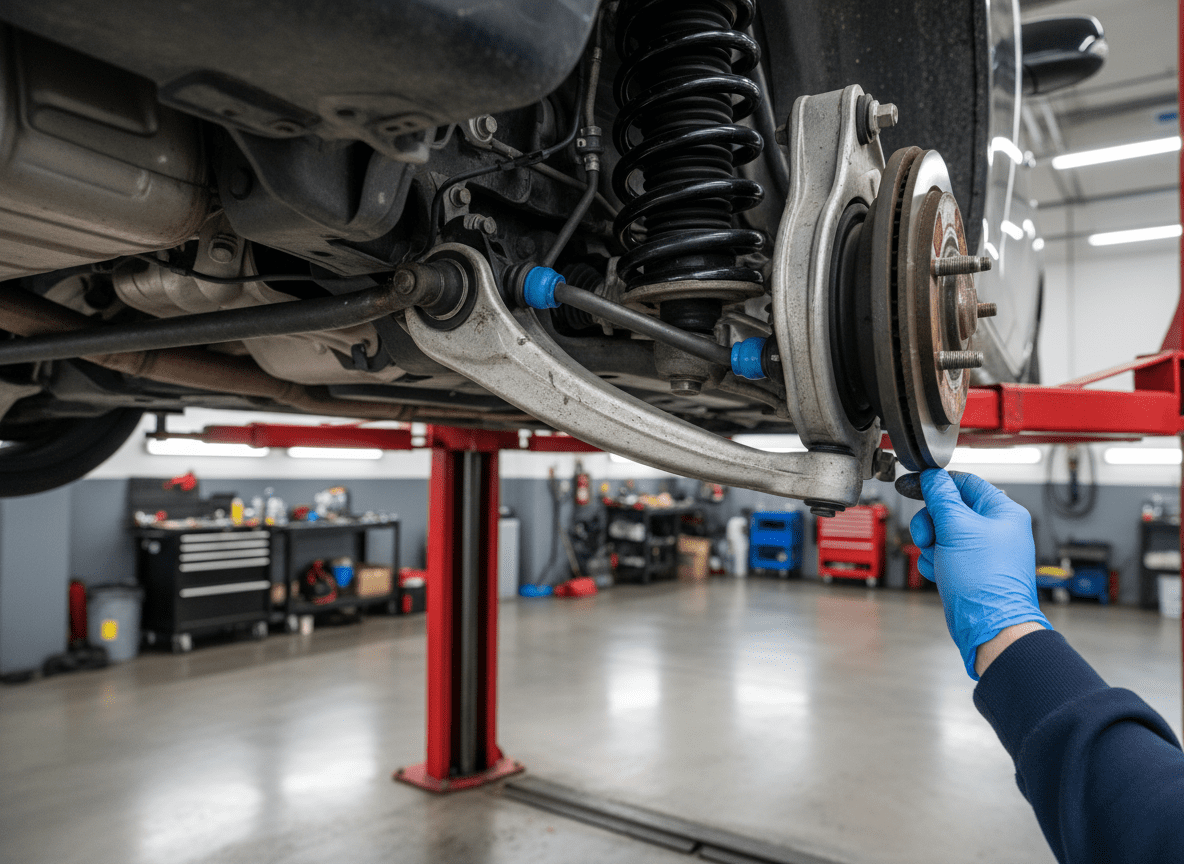
The system is made up of several interconnected components: shock absorbers, coil springs, control arms, anti-roll bars, ball joints, wishbones, and tie rods. Each plays a specific role. When one component wears or fails, it places extra stress on the others, and the symptoms you experience at the wheel reflect which part is under strain.
Because suspension components work together, a fault in one area can feel like a fault in another. That is why proper diagnosis matters — guessing at the cause and replacing parts unnecessarily is expensive and often misses the real problem.
Common Suspension Fault Symptoms to Know
Most suspension problems give early warning before they become serious. The challenge is that drivers often adapt to gradual changes in how the car feels, assuming the difference is normal wear or road surface variation. The symptoms below are signals that something has changed mechanically and needs investigation.
Clunking or knocking
Most commonly caused by worn ball joints, control arm bushes, or anti-roll bar drop links. Usually heard over speed bumps or rough road surfaces.
Pulling to one side
Can indicate unequal spring compression, a seized caliper, worn track rod ends, or alignment issues following component wear.
Bouncy or wallowing ride
Typically points to worn or failed shock absorbers that can no longer dampen spring rebound effectively.
Uneven tyre wear
Inner or outer edge wear, or a cupped/scalloped pattern, often indicates worn shocks, misalignment, or a loose suspension component.
Clunking and Banging Noises Over Bumps
A clunking or knocking sound when going over speed bumps, potholes, or uneven road surfaces is one of the most common suspension fault symptoms we see. The noise can range from a dull thud to a sharp metallic knock, and its location — front or rear, driver’s side or passenger side — helps narrow down the cause.
Ball joints
Ball joints are pivot points that connect the control arm to the steering knuckle. They allow the wheel to move up and down while also allowing steering input. As they wear, the ball begins to move within its socket, creating a knock that worsens over time. A badly worn ball joint can eventually separate, which causes immediate loss of steering control.
Anti-roll bar drop links
Drop links connect the anti-roll bar to the suspension strut or wishbone. They are relatively inexpensive components but prone to wear, particularly on cars driven in urban areas with frequent speed bumps. A worn drop link typically produces a sharp knock at low speed over bumps, often on one side only.
Shock absorber top mounts
The top mount is the rubber and metal assembly that connects the top of the shock absorber to the car’s body. When the rubber deteriorates, the metal components can knock against each other, particularly when the steering is turned fully or when the suspension compresses under load. This produces a clunk from the top of the strut, often felt through the bulkhead as well as heard.
Control arm bushes
Control arm bushes are rubber or polyurethane inserts that allow the control arm to pivot while isolating vibration. When they crack or collapse, the control arm moves more freely than it should, and the result is often a knock under braking or acceleration as well as over bumps.
Pulling or Drifting to One Side
If your car consistently pulls or drifts to one side when you release the steering wheel on a flat, straight road, there is an underlying cause that needs investigation. This is not something that corrects itself — it will worsen over time and increases tyre wear on the affected side.
Worn track rod ends
Track rod ends (or tie rod ends) connect the steering rack to the steering knuckle at each wheel. They have a ball-and-socket joint that allows movement as the suspension rises and falls. When the joint wears, there is play in the steering geometry, which can cause the car to wander or pull. Track rod ends can also cause vague or imprecise steering before the pull becomes noticeable.
Unequal spring compression
If a coil spring on one side has weakened or collapsed, the car will sit lower on that corner. This creates a difference in ride height that causes the vehicle to pull toward the lower side. The symptom is often accompanied by a visibly uneven stance — the car appears to lean to one side when viewed from the front or rear.
Seized brake caliper
While not a suspension component itself, a partially seized brake caliper can mimic a suspension pull symptom. The drag from the seized side causes the car to pull in that direction under braking and sometimes during general driving. A brake inspection alongside the suspension check will confirm this.
Wheel alignment
Suspension component wear changes wheel alignment angles. Even if the worn component is identified and replaced, the alignment will need to be set correctly afterwards to restore straight tracking and prevent premature tyre wear.
Excessive Bounce, Body Roll, or Bottoming Out
A car that continues to bounce after going over a bump, or that rolls excessively through corners, almost always has worn shock absorbers. The shock absorber’s job is to control spring rebound — when you hit a bump, the spring compresses and then tries to return to its original length. The shock absorber resists this return, preventing the car from bouncing repeatedly.
When shock absorbers wear out, they lose their ability to control spring movement. The result is a car that feels unsettled and wallowy, particularly at motorway speeds or through fast corners. Stopping distances also increase, because the wheels are spending more time off the ground and less time in firm contact with the road surface.
Bottoming out — where the suspension compresses fully and the car hits its bump stops — is a more advanced symptom. It usually indicates that the springs have weakened significantly or that the shock absorbers have failed completely. At this point, the car is riding on very little suspension travel, which puts the steering and chassis under stress.
Uneven Tyre Wear as a Suspension Warning Sign
Tyre wear patterns are one of the most reliable indicators of underlying suspension and alignment problems. Normal wear is relatively even across the full width of the tyre. Abnormal wear patterns suggest that the tyre is not sitting at the correct angle, or that it is not being held firmly against the road.
| Wear Pattern | Likely Cause |
|---|---|
| Inner edge wear only | Excessive negative camber — often indicates worn control arm bushes or a bent wishbone |
| Outer edge wear only | Excessive positive camber or overloading — possible spring or bush failure |
| Cupped or scalloped tread | Worn shock absorbers allowing wheel to bounce against the road |
| Feathered or saw-tooth tread | Incorrect toe angle — often caused by worn track rod ends or alignment drift |
| Centre wear only | Overinflation — but also check for alignment if all other pressures are correct |
If you notice any of these patterns, have the suspension inspected before fitting replacement tyres. Replacing tyres without fixing the underlying cause will reproduce the same wear pattern on the new rubber within a few thousand miles.

Steering Vibration, Looseness, and Wandering
Vibration through the steering wheel can have multiple causes — wheel balance, worn tyres, or brake disc issues — but it is also a common suspension fault symptom. The key is to identify at what speed or under what conditions the vibration occurs.
Vibration at specific road speeds
Vibration that appears at a consistent speed and disappears above or below it is usually a wheel balance or tyre issue. However, if it is accompanied by a noise or if the steering wanders as well, worn wheel bearings or a loose hub should be investigated.
Vibration under braking
Steering vibration when braking — often felt as a judder — typically points to warped brake discs. However, if the pedal also pulses, a worn or loose brake caliper mounting could be involved, which overlaps with the suspension system.
Loose or vague steering feel
If the steering feels less precise than it once did, or if there is a degree of free play before the wheels respond, track rod ends, ball joints, or the steering rack itself may be worn. This symptom is important to diagnose accurately because vague steering affects your ability to control the car in an emergency situation.
A full diagnostic inspection will identify whether the cause is suspension, steering, or a combination of both, avoiding unnecessary part replacement.
How We Diagnose Suspension Faults at Star Garage Mansfield
Our approach to suspension faults starts with a proper visual and physical inspection. We raise the car and check each component by hand, feeling for movement in ball joints, play in track rod ends, and condition of shock absorbers. We also look at tyre wear patterns and check for any visible damage to springs, control arms, and bushes.
Where the cause is not immediately obvious, we use diagnostic equipment to read any fault codes from the ABS or stability control systems, which often flag suspension-related issues before the driver notices them.
We confirm the cause before recommending any repair. If a single drop link is the issue, we replace the drop link. We do not recommend replacing shock absorbers simply because the car is a certain age — we base our recommendations on what we find, not on assumptions.
Once repairs are complete, we carry out a post-repair check to confirm the symptom has been resolved and advise on whether a wheel alignment check is needed as a follow-on service.
Suspension Concern? Book an Inspection
If your car is knocking, pulling, or handling differently, don’t leave it. Suspension problems worsen with time and affect your safety.
Call 01623 904724 | Star Garage Mansfield, NG19 9LF | Mon–Fri 8:30am–6:00pm
Frequently Asked Questions
Is it safe to drive with a suspension fault?
It depends on severity. A mild knock over bumps may be safe for a short period, but a car that pulls, bounces excessively, or has a knocking noise on full lock should be inspected as soon as possible. Serious suspension faults — particularly failed ball joints — can cause loss of steering control.
How long does a suspension repair take?
Simple repairs such as drop links, bushes, or shock absorbers typically take two to four hours. More involved work such as wishbone replacement or spring replacements may take half a day. We aim to give accurate time estimates at the point of diagnosis.
Will a faulty suspension affect my MOT?
Yes. Worn ball joints, damaged shock absorbers, excessive play in track rod ends, and broken springs are all MOT failure items. Having suspension inspected before an MOT can prevent a failure and additional costs.
Why is my car pulling to one side after new tyres?
New tyres do not cause pulling on their own. If the car pulls after a tyre change, the most likely causes are incorrect tyre fitting, different tyre models on the same axle, or a pre-existing suspension or alignment issue that the new tyres have made more noticeable.
Does suspension wear affect fuel economy?
Yes, indirectly. Misaligned wheels, worn shock absorbers, and damaged bushes increase rolling resistance and cause the engine to work harder. The difference is usually small, but it adds up over time alongside the accelerated tyre wear that usually accompanies suspension faults.
Need this looked at?
Describe the symptom and we’ll tell you whether it needs a diagnostic slot or a straight booking.
- 5.0 from 235 Google reviews
- Mon–Fri 08:30–18:00
- 2 Warsop Road, Mansfield Woodhouse