A knocking or clunking noise from your suspension is one of those problems that gets easier to ignore the longer it goes on. It starts subtle, gets familiar, and before long it is just part of how the car sounds. That is a mistake. Suspension knocking is the chassis telling you something specific — and the cause is almost always identifiable with the right inspection.
Quick Answer
Suspension knocking noises are most commonly caused by worn anti-roll bar drop links, failed shock absorber top mounts, deteriorated control arm bushes, or worn ball joints. The noise tends to worsen over bumps, on uneven roads, or when turning. A suspension inspection will identify the component at fault — most repairs are straightforward and relatively affordable when caught before the part fails completely.
Contents
What a Knocking Suspension Actually Means
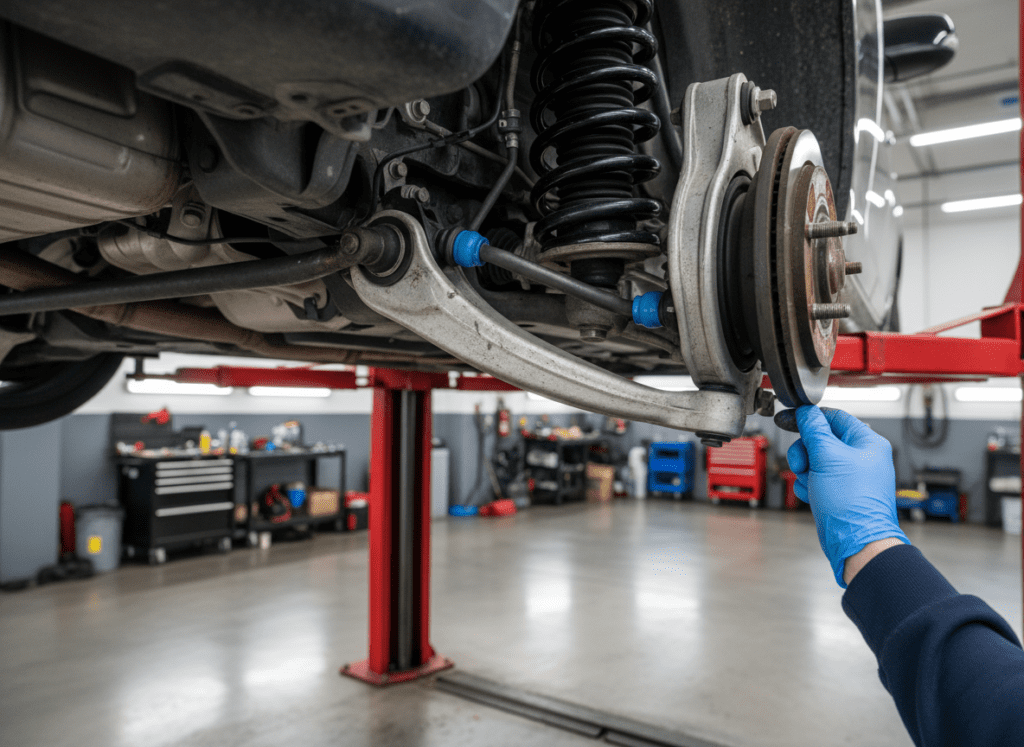
Suspension systems are made up of multiple components that work together to absorb road inputs and keep your wheels in contact with the road. When any one of those components develops wear or play, the parts around it begin to move in ways they are not designed to. That movement — metal against metal, rubber degraded to the point of losing its damping function — produces the knocking and clunking you hear inside the car.
The important distinction is that suspension noise is almost always a mechanical problem, not a coincidence. It is not the car settling, not road surface variation, and not something that will resolve on its own. Every time you go over a bump or pothole with a worn suspension component, that component degrades a little further.
Anti-Roll Bar Drop Links
Drop links connect the anti-roll bar (also called a sway bar) to the suspension strut or lower arm. They are among the most commonly worn suspension components on UK cars, and they are a very frequent cause of knocking noise — particularly over bumps or on uneven surfaces.
Drop links use a ball-and-socket joint at each end. When the rubber boots on these joints crack or perish — which they do with age and road salt exposure — the joint itself loses its grease and begins to develop play. That play produces a knock each time the suspension moves.
The sound is typically a rhythmic knock or clunk that gets worse on rough roads and often improves on smooth motorway surfaces where the suspension is not asked to absorb as much movement. It is usually most noticeable at low speeds.
Drop links are relatively inexpensive to replace — priced on inspection per side including labour — and a straightforward job for a competent independent garage. If caught before the joint fully seizes or snaps, it is a minor repair.
Shock Absorber Top Mounts
At the top of each front shock absorber (strut) sits a rubber mount that allows the strut to pivot as the wheel steers. It also absorbs the vertical impact that reaches the top of the strut when the wheel goes over a bump.
When the rubber in the top mount deteriorates, it loses its ability to dampen that impact. You get a clunk — sometimes quite a sharp one — each time the suspension compresses and rebounds. The noise often sounds like it is coming from directly under the bonnet or behind the dashboard on the relevant side.
A tell-tale sign of a failing top mount is a knocking that is most pronounced on harsh bumps or when parking over speed humps at low speed. Some drivers also notice a slight grinding or creaking noise when turning at low speed, as the bearing inside the top mount becomes worn.
How Long Do Top Mounts Last?
Top mount lifespan varies significantly by vehicle and driving conditions. On UK roads with a high frequency of potholes and speed bumps, 60,000–80,000 miles is a reasonable expectation. Cars driven predominantly in urban areas with rough surfaces tend to wear them faster.
Control Arm and Subframe Bushes
Rubber bushes are found throughout the suspension system. They allow components to flex and absorb vibration while maintaining correct geometry. Control arm bushes, subframe bushes, and trailing arm bushes are all common failure points on higher-mileage vehicles.
When a bush deteriorates — the rubber cracks, hardens, or collapses — the metal components it was separating begin to contact each other directly. The result is a thudding or clunking noise that is often felt through the floor of the car as well as heard.
Worn subframe bushes in particular can cause a deep, resonant thud over larger road imperfections. It can feel as though something substantial has shifted, which understandably concerns drivers. It is a significant noise but not necessarily a dramatic repair — though it does require proper diagnosis to confirm the source.
Ball Joints
Ball joints connect the steering knuckle to the suspension arm and allow the wheel to move up and down as well as pivot for steering. They are a critical structural component — a completely failed ball joint can cause the wheel to detach from the vehicle while driving.
Early signs of a worn ball joint include a knock or clunk when going over bumps, often accompanied by a slight wobble or vibration through the steering wheel. As the joint deteriorates further, you may notice uneven tyre wear and imprecise steering response.
Ball joints develop play as their internal components wear. Early on, this play produces intermittent noise. Later, the movement becomes significant and the noise is consistent. At this stage, the MOT will flag them as a reason for failure — and rightly so, as they represent a genuine safety risk.
Worn Shock Absorbers and Struts
Shock absorbers dampen the movement of the suspension springs, controlling how the car settles after a bump. When they wear out, they no longer control spring movement effectively. The car bounces more than it should, and the suspension can produce a rhythmic knocking as it oscillates through its travel.
Worn shocks also change how the car handles under braking and cornering. It may feel like the front dives excessively under braking, or that the body rolls more than expected through corners. These handling changes are often noticed before a knocking noise appears.
Replacing shock absorbers in pairs (both fronts or both rears together) is standard practice. This maintains balanced handling and avoids the uneven feel that comes from one new and one worn absorber on the same axle.
How to Read the Knock: Diagnosis Clues
The characteristics of the noise can help narrow down the likely cause before a physical inspection:
| Noise Type | When It Happens | Likely Cause |
|---|---|---|
| Light, regular knock | Over bumps, worse at low speed | Drop links, top mount |
| Deep thud or clunk | Over large bumps, potholes | Subframe or control arm bushes |
| Sharp knock when turning | Parking, slow manoeuvring | Top mount bearing, CV joint |
| Knock under braking | Braking from speed | Control arm bush, loose caliper |
| Intermittent knock, worst in cold | First few miles, cold mornings | Top mount, hardened bushes |
| Scraping or grinding over bumps | Full compression | Shock absorber internals, coil spring |
These are useful pointers but not definitive. More than one component can produce the same type of noise, and some faults only become apparent on a ramp where each component can be checked manually for play and wear.
What Happens If You Ignore Suspension Noise
Suspension problems rarely stay static. A worn drop link that knocks will eventually fail completely, leaving the anti-roll bar disconnected. A ball joint with play will develop more play with every bump it absorbs. Worn bushes allow adjacent components to wear faster.
Beyond the mechanical progression, there is an MOT consequence. Suspension components are part of the MOT inspection. A failed ball joint, severely worn bushes, or a completely failed drop link will result in an MOT failure. Addressing the issue before your next MOT is always less stressful and usually cheaper than dealing with a failure notice and a tight repair window.
The handling implications are worth considering too. A car with compromised suspension does not respond to steering and braking inputs in the way the manufacturer intended. Under normal daily driving this is a gradual degradation that adapts to without noticing. In an emergency stop or evasive manoeuvre, the difference becomes relevant.
Suspension Repair Costs UK
| Component | Urgency |
|---|---|
| Anti-roll bar drop links | Medium — replace soon |
| Shock absorber top mount | Medium — replace in pairs |
| Control arm with bushes | Medium–high |
| Ball joint replacement | High — safety critical |
| Shock absorber replacement | Medium — replace in pairs |
| Subframe bush replacement | Medium |
| Suspension inspection | First step |
How We Diagnose Suspension Knocking at Star Garage Mansfield
We inspect the suspension on a ramp where each component can be tested properly. Checking a suspension by ear alone is not sufficient — many components only reveal their wear when held and physically moved. On a ramp, we can apply force to each joint, bush, and link to feel for play and confirm where the movement is coming from.
We check anti-roll bar drop links, top mounts, control arm bushes, ball joints, shock absorbers, and steering components as part of a standard suspension inspection. Where we find wear, we show you what we found and explain what it means in plain terms.
We will also flag any components that are close to failing but not yet the primary cause of the noise — this gives you the full picture so you can make an informed decision about what to address now and what to monitor.
Our suspension repair service covers all suspension work, from drop links and top mounts through to more involved bush replacement and shock absorber fitting. We use quality parts and quote before any work begins. If you also need a diagnostic inspection for a warning light or related fault, we can combine both.
Frequently Asked Questions
Is a knocking suspension dangerous?
It depends on the component. Worn drop links are not immediately dangerous but degrade handling. Ball joints in advanced wear are safety-critical — a complete failure can cause wheel separation. The only way to assess the severity is a proper inspection. Do not assume minor noise means minor risk without having it checked.
Will my car fail its MOT with suspension noise?
If the noise is caused by worn or failed safety-critical components — particularly ball joints, steering joints, or severely deteriorated bushes — then yes, an MOT failure is likely. Drop links that have failed will also cause an MOT fail. It is better to address suspension issues before presenting the car for its MOT.
Why does the knock get worse in cold weather?
Rubber bushes and top mount insulators become stiffer and less effective in cold temperatures. If they are already worn, the reduced flexibility means more direct contact between metal components, which produces louder or more frequent noise until the components warm up. Cold-weather worsening is a useful indicator that rubber components are involved.
Can suspension noise affect wheel alignment?
Yes. Worn control arm bushes and ball joints allow the wheel to move out of its intended position, which affects toe and camber alignment. This can cause uneven tyre wear and pulling to one side. If you are noticing uneven tyre wear alongside the knock, a suspension inspection and alignment check are both worth doing.
How long can I drive with a knocking suspension?
This depends on what is causing it. Drop link noise can often be managed for a few weeks without immediate safety risk. Ball joint noise should be assessed urgently. As a general principle, if the knock is new, getting progressively worse, or accompanied by handling changes, book an inspection rather than waiting for a convenient moment.
Suspension Knocking? We Can Find the Cause
We inspect suspension on a ramp so we can show you exactly what is worn and what it needs. No guesswork, no unnecessary parts — a clear diagnosis and honest advice before any work begins.
Located in Mansfield Woodhouse, Mansfield. Serving drivers across Mansfield, Worksop, Chesterfield, and Nottingham. Open Monday–Friday, 8:30 AM to 6:00 PM. Phone: 01623 904724
Need this looked at?
Describe the symptom and we’ll tell you whether it needs a diagnostic slot or a straight booking.
- 5.0 from 235 Google reviews
- Mon–Fri 08:30–18:00
- 2 Warsop Road, Mansfield Woodhouse


