A failing catalytic converter rarely announces itself dramatically. It creeps up — a strange smell here, a hesitation there, then an engine management light, and eventually a failed MOT. Understanding the warning signs early is the difference between a manageable repair and an expensive replacement.
Quick Answer
Common catalytic converter fault symptoms include a rotten egg or sulphur smell from the exhaust, an engine management light (often P0420 or P0421), reduced power particularly at higher speeds, a rattling noise from under the car, and increased exhaust emissions that can cause MOT failure. Diagnosis requires a scan, emissions test, and often a physical inspection. Replacement is priced on inspection depending on vehicle make and cat type.
What Does a Catalytic Converter Do?
The catalytic converter sits in the exhaust system between the engine and the silencer. Its job is to convert harmful exhaust gases — carbon monoxide, hydrocarbons, and nitrogen oxides — into less harmful substances before they leave the tailpipe.
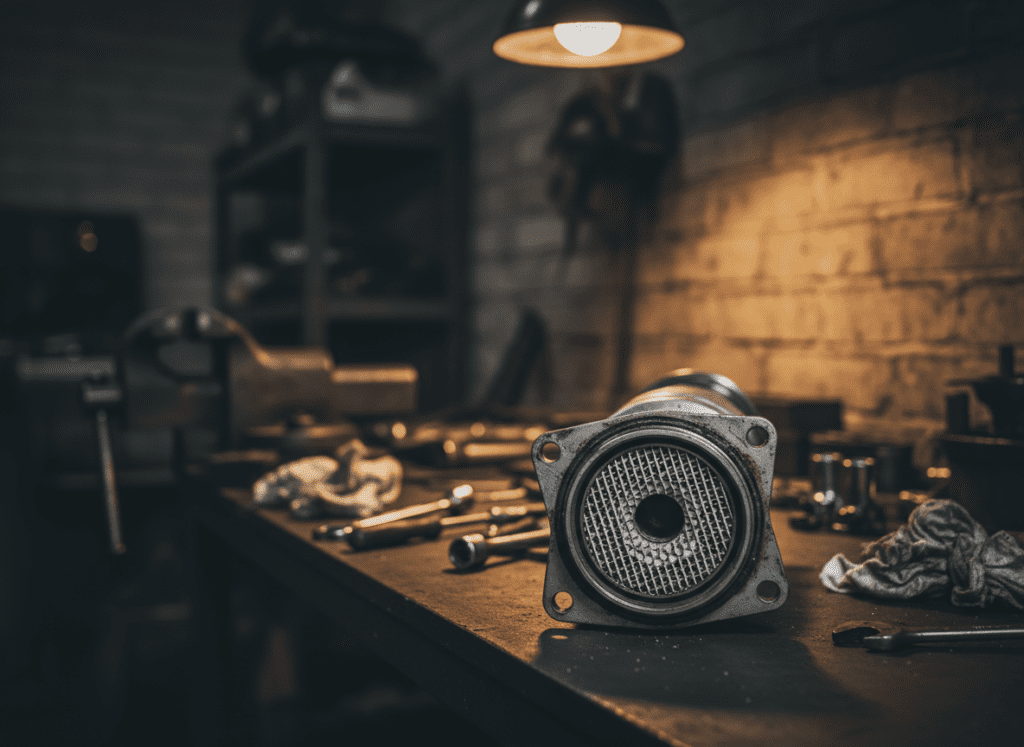
Inside the converter is a honeycomb-like ceramic or metallic substrate coated with precious metals: platinum, palladium, and rhodium. As hot exhaust gases pass through, these metals act as catalysts — triggering chemical reactions that clean the gases without being consumed themselves.
Petrol vehicles use a three-way catalyst. Diesel vehicles use an oxidation catalyst (DOC), often working alongside a DPF and an SCR (selective catalytic reduction) system that uses AdBlue. This post focuses primarily on petrol cats, though many symptoms overlap.
The oxygen sensors (lambda sensors) before and after the catalytic converter monitor how effectively the converter is working. If the downstream sensor detects exhaust gas composition similar to the upstream sensor, it means the cat is not doing its job — and that triggers the P0420 code.
Catalytic Converter Fault Symptoms
1. Sulphur or Rotten Egg Smell from the Exhaust
This is often the earliest noticeable sign. A healthy catalytic converter converts hydrogen sulphide in the exhaust into sulphur dioxide, which is odourless. When the converter starts failing, this conversion breaks down and you get a distinctive rotten egg smell from the exhaust.
The smell tends to be most noticeable when the engine is warm and you have just been driving at higher speeds. It can be intermittent in the early stages before becoming persistent as the fault worsens.
2. Engine Management Light (P0420 or P0421)
The P0420 fault code — “Catalyst System Efficiency Below Threshold (Bank 1)” — is one of the most common engine management codes in the UK. It means the downstream oxygen sensor has detected that the catalytic converter is no longer cleaning exhaust gases effectively.
P0421 is a warm-up catalyst efficiency code, often seen on vehicles with a secondary smaller cat closer to the engine. Both point to catalyst degradation or failure.
3. Reduced Power at Higher Engine Speeds
A physically blocked catalytic converter creates exhaust back-pressure. The engine cannot push exhaust gases out efficiently, which restricts airflow through the engine and reduces power output. This is usually felt at higher revs — the car may pull strongly at lower speeds but fall flat above 3,000–4,000 rpm.
In severe cases, a heavily blocked cat can put the engine into limp mode as back-pressure becomes extreme.
4. Rattling Noise from Under the Vehicle
The ceramic substrate inside the converter can crack or break down — particularly after physical damage, overheating, or contamination. When the internal structure breaks up, it rattles around inside the converter casing as you drive. The noise is most obvious on start-up, over rough roads, or when accelerating.
A rattling catalytic converter almost always needs replacement rather than repair. The internal damage cannot be undone.
5. Failed Emissions Test or MOT
An underperforming catalytic converter allows unburned hydrocarbons and carbon monoxide to pass through at levels that breach MOT emissions limits. If your vehicle fails the exhaust emissions test at MOT, a faulty catalytic converter is high on the list of causes.
6. Increased Fuel Consumption
When the ECU detects catalyst inefficiency via the downstream oxygen sensor, it may adjust fuelling in an attempt to compensate. This adjustment is not perfect, and some vehicles respond with richer fuelling — increasing fuel consumption. A progressive increase in fuel usage, combined with other symptoms, is worth investigating.
7. Heat and Burning Smell from the Exhaust Area
If unburned fuel reaches a degraded catalytic converter, it can combust inside the converter itself rather than in the engine. This can cause the converter to overheat — and in serious cases, glowing red-hot underneath the vehicle. A burning smell or unusual heat from the underside of the car should be treated as urgent.
Understanding the P0420 Fault Code
P0420 is one of the most misunderstood fault codes because several different faults can trigger it. The code itself means: the ECU has compared the upstream and downstream oxygen sensor readings, found them too similar, and concluded the catalytic converter is not converting enough of the exhaust gas.
What Triggers P0420 — It Is Not Always the Cat
Before replacing the catalytic converter on a P0420 code, it is essential to rule out other causes:
- Faulty downstream oxygen sensor: If the rear lambda sensor is reading incorrectly, it can produce a P0420 without the cat actually being at fault.
- Exhaust leaks: A leak between the engine and the downstream sensor skews the reading, making the cat appear inefficient.
- Running rich or lean: A fuel system fault causing incorrect air-fuel mixture can overwhelm even a healthy catalytic converter, triggering P0420.
- Oil burning: Burning oil (worn piston rings, valve stem seals) coats the catalyst substrate with deposits, poisoning the precious metals over time.
- Coolant in the exhaust: A head gasket leak allowing coolant into the combustion chamber rapidly destroys the catalyst substrate.
What Causes Catalytic Converter Failure?
Normal End-of-Life Wear
Catalytic converters are designed to last the life of the vehicle in normal conditions — typically 100,000+ miles. However, the precious metal coating on the substrate does degrade slowly. On high-mileage vehicles, the converter simply loses efficiency over time. This is gradual rather than sudden.
Oil or Coolant Contamination
This is one of the most destructive causes. Oil burning caused by worn engine internals coats the catalyst substrate with ash and hydrocarbons. Coolant entering the combustion chamber from a head gasket failure floods the converter with steam and contaminants. Either situation can permanently damage the substrate in a short period.
Physical Impact
Speed bumps, potholes, and road debris can physically crack or break the ceramic substrate inside the converter. Once the internal structure is compromised, the converter cannot function properly and will rattle. This type of failure requires replacement rather than repair.
Overheating
If the catalytic converter is exposed to excessive heat — typically from misfires or unburned fuel igniting inside the converter — the substrate melts or fuses. A single serious misfire event can cause irreversible damage. This is why misfires should always be diagnosed and fixed promptly.
Ethanol-Blended Fuel Effects
E10 fuel, now standard in the UK, burns slightly differently from E5. For most modern vehicles, the impact on catalytic converter life is minimal. However, on older vehicles or those already running fuel system issues, the slightly higher combustion temperatures can accelerate degradation.
Catalytic Converter Faults and MOT Failure
The emissions test at MOT checks carbon monoxide, hydrocarbons, and lambda values at idle and fast idle. A failing catalytic converter typically causes failures in CO and hydrocarbon readings.
| MOT Emissions Check | What a Healthy Cat Achieves | What a Failing Cat Produces |
|---|---|---|
| Carbon monoxide (CO) at idle | Below 0.3% (post-2002 petrol) | Can exceed 1–3%+ |
| Hydrocarbons (HC) at fast idle | Below 200 ppm | Can exceed 500–1,000+ ppm |
| Lambda reading | 0.97–1.03 (near stoichiometric) | Outside acceptable window |
It is worth noting that a P0420 fault code alone does not automatically mean an MOT failure. The vehicle needs to fail the actual emissions measurement — or have a permanent management light on — for it to be a definitive fail. However, a stored catalyst efficiency code is a strong indicator that an emissions failure is imminent.
How We Diagnose Catalytic Converter Problems
A thorough diagnosis at Star Garage Mansfield covers the full picture — not just reading the fault code:
- Full system scan: We read all stored and pending codes across all modules, not just the P0420.
- Oxygen sensor live data: We compare upstream and downstream sensor behaviour in real time. A faulty lambda sensor often looks similar to a failing cat on code alone — live data separates them.
- Fuel trim analysis: If the engine is running rich or lean, we identify whether this is a root cause driving the P0420.
- Exhaust physical check: We inspect for cracks, damage, and physical rattling under the vehicle.
- Engine condition check: If oil burning or coolant loss is suspected, we address that first — fitting a new converter without fixing the underlying cause means it will fail again.
We explain what we find clearly before any repair work starts. You know what the problem is, what the fix involves, and what it costs before we touch anything.
Catalytic Converter Repair and Replacement Costs
| Work Required | Notes |
|---|---|
| Diagnostic scan + oxygen sensor analysis | Always the starting point |
| Lambda (oxygen) sensor replacement | If sensor is the cause rather than the cat |
| Exhaust repair / leak fix | If exhaust leak is skewing readings |
| Catalytic converter replacement (budget part) | Aftermarket cat; may not match OEM efficiency |
| Catalytic converter replacement (OEM-spec) | Premium vehicles, close-coupled cats, complex installs |
Frequently Asked Questions
Can I drive with a failing catalytic converter?
In most cases, yes — but it depends on the severity. A converter that is simply losing efficiency will allow the car to run normally but with increased emissions. A physically blocked converter creates back-pressure that can cause limp mode and potential engine damage. A rattling converter suggests the substrate has broken up and fragments may be drawn into the engine — this needs attention soon.
Will a failing catalytic converter always trigger the engine management light?
Not immediately. In the early stages of degradation, the converter may be below its peak efficiency but still within the ECU’s acceptable range. The light typically appears once efficiency drops below a defined threshold. You may notice a smell or minor power loss before the light triggers.
Is a cheap aftermarket catalytic converter worth fitting?
Budget aftermarket converters may pass emissions at MOT but are often less efficient than OEM units. They can degrade faster and may trigger P0420 within 12–24 months on some vehicles. For most drivers, a mid-range or OEM-equivalent converter offers better long-term value. We advise on the appropriate part for your vehicle and usage.
What is the difference between the catalytic converter and the DPF?
The catalytic converter converts harmful gases into less harmful ones through chemical reactions. The DPF (Diesel Particulate Filter) physically traps soot particles from diesel exhaust and burns them off periodically through regeneration. Diesel vehicles often have both systems working together. A blocked DPF is a different problem from a failing diesel oxidation catalyst, though both can trigger exhaust warning lights.
My car smells of sulphur occasionally — does it definitely need a new cat?
Not necessarily. An occasional sulphur smell can occur during a DPF regeneration cycle on diesel vehicles, after short trips where the cat has not fully warmed up, or after extended idling. If the smell is persistent, worsening, or accompanied by a management light, that warrants a diagnostic check rather than assumption.
Engine Management Light or Exhaust Issues? Book a Diagnostic
If you have a P0420 code, a sulphur smell, or suspect your vehicle may fail its emissions test, we will diagnose the root cause properly before recommending any parts. No parts-swapping. No guesswork. Honest diagnosis from a local independent garage.
Star Garage Mansfield — 2 Warsop Road, Mansfield Woodhouse, Mansfield, NG19 9LF. Serving drivers across Mansfield, Worksop, Chesterfield, and Nottingham. Open Monday–Friday, 8:30 AM to 6:00 PM. Phone: 01623 904724
Need this looked at?
Describe the symptom and we’ll tell you whether it needs a diagnostic slot or a straight booking.
- 5.0 from 235 Google reviews
- Mon–Fri 08:30–18:00
- 2 Warsop Road, Mansfield Woodhouse