The coolant temperature warning light is one of the most urgent warnings your car can give you. Ignore it and you risk a warped cylinder head, a blown head gasket, or a seized engine. This guide explains what causes it, what to do immediately, and how to avoid a very expensive mistake.
What the Coolant Temperature Warning Light Actually Means
Your engine runs at a tightly controlled temperature — typically between 80°C and 100°C. The cooling system uses a mixture of coolant (antifreeze) and water to absorb heat from the engine and release it through the radiator.
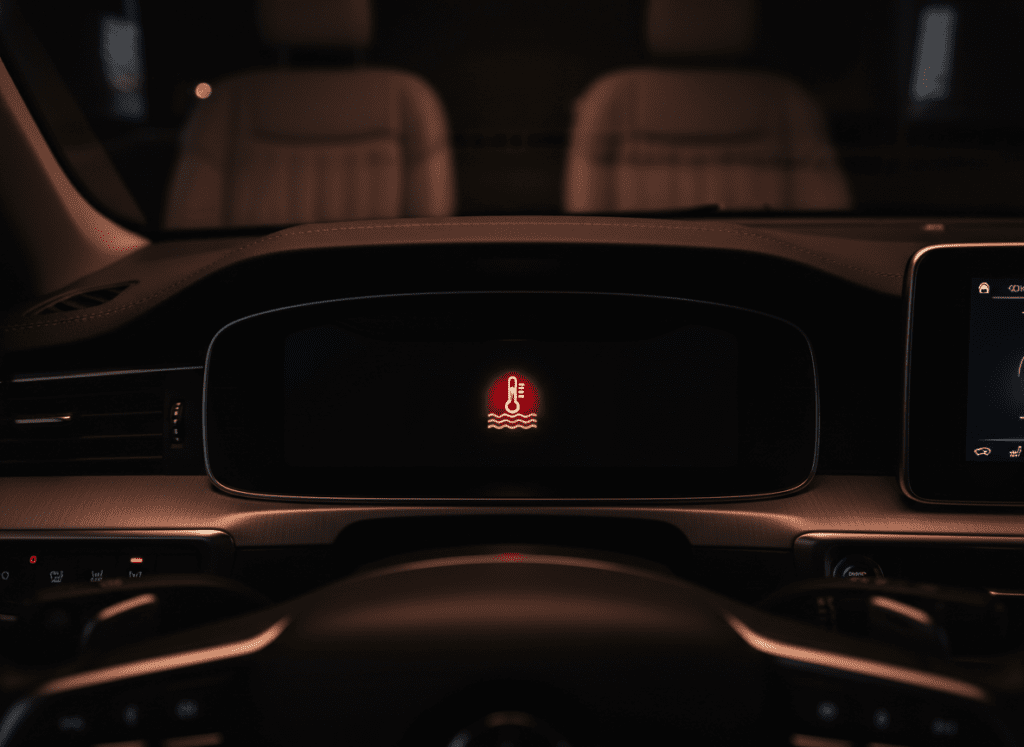
When something goes wrong with that system, the coolant temperature rises above the safe operating range. The engine control unit detects this and triggers the temperature warning light — usually a red thermometer symbol, sometimes with waves underneath.
This is not a minor inconvenience. Overheating causes damage that can cost thousands of pounds to repair. In many cases, the damage happens within minutes of the light appearing.
Common Causes of the Coolant Temperature Warning Light
1. Low Coolant Level
This is the most common cause. Coolant can be lost through small leaks, evaporation over time, or a more serious internal leak such as a failing head gasket. When the level drops, the cooling system cannot circulate enough fluid to keep the engine temperature stable.
Check the coolant reservoir (a translucent plastic bottle near the radiator, with MIN and MAX markings). If it is below the minimum line, you have lost coolant somewhere.
Important: Never open the radiator cap or coolant reservoir cap when the engine is hot. The system is pressurised and can release scalding coolant. Wait at least 30 minutes after switching the engine off.
2. Thermostat Failure
The thermostat is a valve that controls coolant flow through the engine. It stays closed when the engine is cold (to help it warm up quickly) and opens once the engine reaches operating temperature.
If the thermostat sticks closed, coolant cannot circulate. The engine overheats even if the coolant level is fine. Thermostat failure is one of the more common causes we see at Star Garage Mansfield, particularly on older vehicles.
Signs: The temperature gauge climbs steadily after a few miles. The heater may also stop producing warm air.
Cost to replace: Typically priced on inspection including parts and labour, depending on the vehicle.
3. Coolant Leak
Coolant can leak from several places: hose connections, the radiator itself, the water pump, the heater matrix, or the head gasket. Some leaks are visible — you may see green, orange, or blue fluid under the car. Others are internal and much harder to detect.
External leaks often leave a sweet smell when the engine is hot. If you are regularly topping up coolant but cannot see where it is going, you may have an internal leak — which needs proper diagnosis.
4. Failed Water Pump
The water pump circulates coolant around the engine continuously. If the pump impeller corrodes, the bearings fail, or the drive belt snaps, coolant stops moving. The engine overheats rapidly.
On many modern diesel engines — particularly VAG group and BMW — the water pump is driven by the timing belt or chain. If this fails, it often comes with other serious symptoms. Water pump replacement is frequently done alongside timing belt or timing chain work to save labour costs.
5. Radiator Problems
The radiator can become clogged with debris, corroded internally, or damaged externally. A blocked or damaged radiator cannot release heat effectively, causing temperature to climb.
Radiator failure is less common than the above causes but worth investigating if coolant level and thermostat have already been checked.
6. Head Gasket Failure
This is the most serious cause on this list. The head gasket seals the combustion chambers from the cooling system. When it fails, combustion gases can enter the coolant, and coolant can enter the cylinders.
Signs of head gasket failure alongside overheating: white smoke from the exhaust, sweet-smelling exhaust, milky oil (a creamy residue under the oil cap), or bubbling in the coolant reservoir when the engine runs.
If you suspect a blown head gasket, stop driving immediately. Continuing to drive with a failed head gasket will cause catastrophic engine damage.
What to Do When the Light Comes On
Step 1: Pull Over Safely and Switch Off
As soon as it is safe to do so, pull over and switch the engine off. Do not try to drive to a garage if the temperature gauge is in the red or the light is red. The risk of causing serious engine damage outweighs the inconvenience of stopping.
Step 2: Wait Before Checking Anything
Leave the car for at least 20–30 minutes before opening the bonnet. Never remove the radiator cap or coolant cap while the engine is hot.
Step 3: Check the Coolant Level
Once the engine is cool, check the coolant reservoir level. If it is low, you can top up with a 50/50 mix of antifreeze and distilled water as a temporary measure. But the underlying cause still needs to be found.
Step 4: Get the Car Diagnosed
Even if topping up the coolant clears the warning light, that is not a fix. The coolant went somewhere. If you do not find where, the problem will return — potentially at a worse moment.
Repair Costs: What to Expect
| Problem | Urgency |
|---|---|
| Coolant top-up and leak check | Immediate |
| Thermostat replacement | High |
| Water pump replacement | High |
| Radiator replacement | Medium–High |
| Coolant hose replacement | High |
| Head gasket repair | Immediate |
The earlier a cooling system problem is caught, the cheaper the repair. A failed thermostat caught early costs a few hundred pounds. The same problem ignored until the head gasket blows can cost as much as the car is worth.
Can You Prevent Overheating?
Most cooling system failures give warning signs before the temperature light comes on. Paying attention to these early signals can help you avoid a roadside breakdown or serious engine damage.
- Check coolant level regularly: Monthly is ideal. The reservoir should be between MIN and MAX at all times.
- Change coolant on schedule: Coolant degrades over time and loses its anti-corrosion properties. Most manufacturers recommend changing it every 3–5 years.
- Watch the temperature gauge: A needle that creeps higher than usual, or that takes longer to reach normal operating temperature, signals a problem.
- Smell anything sweet? A sweet smell when the engine is warm can indicate a coolant leak, even if you cannot see it.
- Book servicing on time: Cooling system components are often inspected during routine servicing. Catching worn hoses or a weeping water pump early prevents bigger failures.
How We Diagnose Cooling Problems at Star Garage Mansfield
When you bring your car to us with a coolant temperature warning, our process is straightforward. We start with a full diagnostic scan to read any stored fault codes and check live sensor data from the coolant temperature sensor and thermostat circuits.
We then pressure test the cooling system to check for external leaks, and inspect the coolant condition for signs of contamination (which can indicate head gasket issues). If a leak is present, we find it before recommending any parts.
We confirm the cause before we quote for a repair. If it’s a thermostat, we tell you. If it looks like a head gasket, we tell you that too — honestly, with an accurate assessment of what it will cost and what your options are.
We carry out all cooling system repairs including water pump replacements, thermostat changes, hose replacements, and radiator work. If you need a timing chain or belt replacement at the same time as a water pump, we can combine the work to save you labour costs.
Frequently Asked Questions
Can I drive with the coolant temperature light on?
No. A red temperature warning light means the engine is overheating. Pull over safely and switch the engine off. Continuing to drive risks warping the cylinder head or destroying the engine entirely.
What does the coolant temperature light look like?
It is usually a red or amber thermometer symbol, sometimes shown with wavy lines underneath to represent liquid. On some cars it may appear as a gauge in the red zone rather than a separate icon.
Can I just top up the coolant and keep driving?
Topping up may get you moving temporarily, but the coolant went somewhere. The underlying leak or fault still needs to be diagnosed. Repeatedly topping up without fixing the cause often ends in a blown head gasket.
How do I know if my head gasket has blown?
Signs include white smoke from the exhaust, a sweet smell from the exhaust, milky residue under the oil filler cap, and coolant loss with no visible external leak. A proper diagnostic and pressure test will confirm it.
How much does it cost to fix an overheating engine?
It depends entirely on the cause. A thermostat replacement is priced on inspection. A head gasket repair is priced on inspection depending on the vehicle. Diagnosis first — don’t guess at parts.
Is the coolant temperature sensor the same as the thermostat?
No. The coolant temperature sensor measures and reports the temperature. The thermostat is a mechanical valve that controls coolant flow. Both can fail independently and produce overheating or incorrect gauge readings.
Coolant Warning Light On? Get It Checked Today
Do not guess. We will run a full cooling system check, pressure test for leaks, and confirm the cause before any repair work starts. Serving drivers across Mansfield, Worksop, Chesterfield, and Nottingham.
Located in Mansfield Woodhouse, Mansfield. Serving drivers across Mansfield, Worksop, Chesterfield, and Nottingham. Open Monday–Friday, 8:30 AM to 6:00 PM. Phone: 01623 904724
Need this looked at?
Describe the symptom and we’ll tell you whether it needs a diagnostic slot or a straight booking.
- 5.0 from 235 Google reviews
- Mon–Fri 08:30–18:00
- 2 Warsop Road, Mansfield Woodhouse