

This BMW 640d M Sport came in for an oil leak. By the time Marcin had finished diagnosing it, the leak was the least of its problems: the oil filter was clogged with thick engine sludge, there were traces of metal in it, and the car had gone more than 50,000 miles without a service. This is what we found, what we tested, and why the next step is not a simple one.
Quick Answer: What Is Engine Sludge?
Watch the job:
What the BMW 640d Came In With
The booking was for an oil leak. When the car arrived it was also smoking, and the oil pressure warning light was on. None of those three things on its own is unusual. Together, on a car with no service history for more than 50,000 miles, they pointed somewhere more serious.
Marcin started where you always should with an oil-related fault: the oil and the filter. The filter was clogged with thick, sludgy oil. Mixed into that sludge were traces of metal.

That changes the job completely. An oil leak is a sealing problem. Sludge and metal in the filter are evidence that something inside the engine has been running without the protection it needs.
How Engine Sludge Forms
Fresh engine oil does two jobs: it lubricates, and it carries contaminants away to the filter. Over time the oil breaks down. Heat oxidises it, combustion by-products and moisture get into it, and the additives that keep dirt suspended are used up. Eventually the oil stops carrying the contamination and starts depositing it.
That deposit is sludge. It is described as a gel-like deposit capable of blocking the oil pump inlet screen and oil channels, which starves the engine of oil. The engine is then trying to pump something closer to paste than oil through passages designed for a thin fluid.
It is not only neglect that speeds this up. In trade guidance for workshops, Castrol points to frequent short journeys, low-quality fuel, late or missed oil changes and stop-start driving as the conditions that make sludge worse. Put 50,000 miles on one fill of oil and every one of those factors has had years to do its work.
What Metal in the Oil Filter Tells Us
Sludge on its own is bad news. Metal in the sludge is worse, because it means something has been wearing. The oil filter is doing its job by catching those particles; the question is where they came from.
The honest answer is that a filter cannot tell you that on its own. Metal particles can come from bearings, from the timing drive, from the valvetrain or from anywhere else two surfaces have been rubbing without enough oil between them. That is exactly why this job did not stop at “change the oil”.
It is also why the oil pressure warning matters so much here. If sludge has partly blocked the oil pick-up, the pump cannot deliver enough oil, pressure drops, and wear accelerates. We have seen that endgame before on a much smaller car: our Ford KA case where sludge blocked the oil strainer shows what a clogged pick-up looks like once it is out of the engine.
What We Did: Flushing, Testing and Measuring
The aim was to find out whether the engine could be cleaned out and saved, or whether the damage was already done. That meant testing, not guessing.
- Multiple oil and filter changes. We carried out repeated oil and filter changes, running fresh oil through the engine to see whether the sludge could be cleared out.
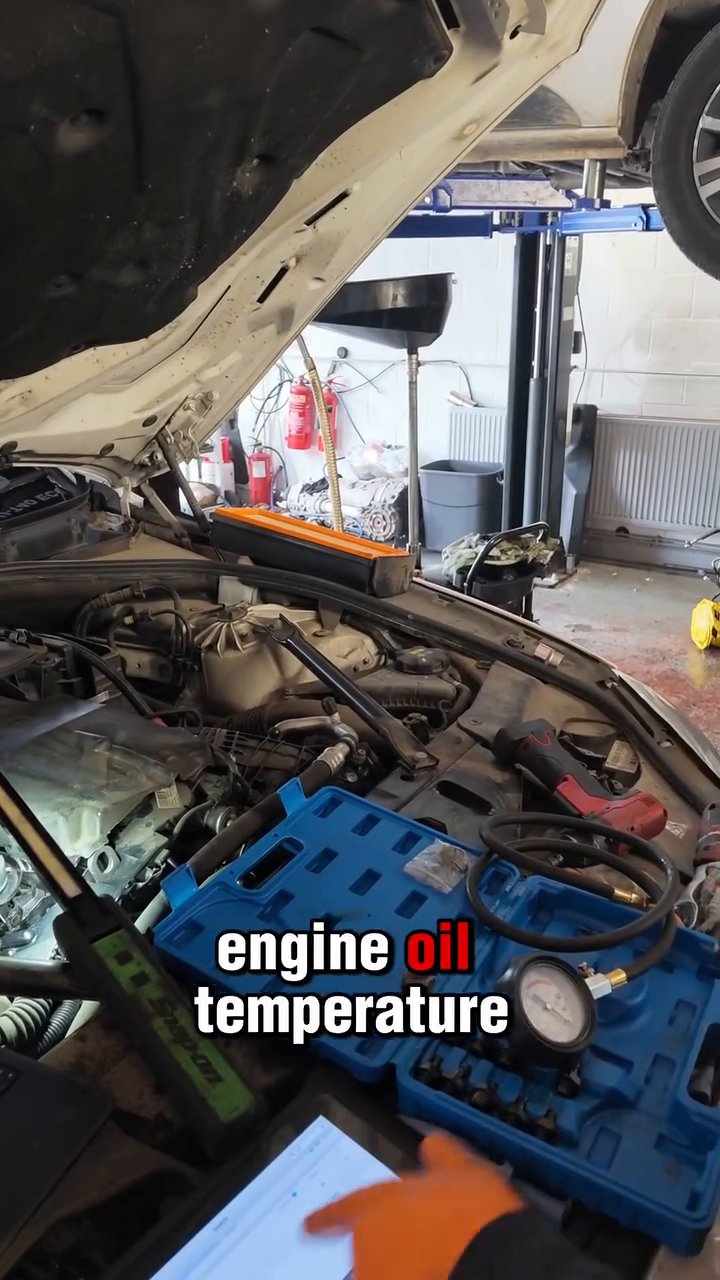
- An oil pressure test with a gauge. Rather than relying on the dashboard light, Marcin measured oil pressure directly with a gauge at operating temperature, which is the only way to know what the engine is really producing.
- Checking where the oil was going. Following the original complaint of an oil leak and smoke, we found the turbo leaking oil.
Why the Turbo Leak Is Part of the Same Story
It would be easy to treat the leaking turbo as a separate fault that happened to turn up on the same car. We do not see it that way. A turbocharger spins at extremely high speed on a shaft that floats on a film of engine oil, and the same oil carries heat away from it.
When that oil is old, thick and full of contamination, the turbo is one of the first components to feel it. Its bearings and seals depend on a clean, steady supply, and a starved or contaminated feed is a well-known route to worn seals and oil getting where it should not.
So the smoke and the oil leak the car was booked in for are not a coincidence sitting alongside the sludge. On a car that missed this much servicing, they are very likely symptoms of it. Replacing the turbo without dealing with the oil supply behind it would only put a new part on the same problem.
Where This Engine Sludge Job Goes Next
This is the part most case studies skip, so we will be straight about it: we do not yet know whether this engine can be saved.
Marcin’s view at the end of the testing was that the sensible next step is to take the engine out. With it out, we can check the sump and the oil pick-up for the sludge that flushing cannot reach, inspect the timing, and look under the rocker cover at the condition of the valvetrain. Those are the places a filter full of metal is pointing at.
Whether we do that is the customer’s decision, and it is being agreed with them now. Taking an engine out to look properly is a significant job, and nobody should be pushed into it. What we will not do is tell an owner the car is fixed because the oil is clean for now.
If you want to understand why some faults can only be diagnosed with the engine removed, our guide to engine-out jobs explains it.
What Happens If You Don’t Service Your Car
This BMW is the clearest example we can give. Regular servicing can feel like an expense, especially on a car that seems to be running fine. But oil does not fail loudly. It degrades quietly, the engine keeps running, and the first obvious sign is often a warning light, smoke or a leak — by which time the damage may already be inside the engine.
- Oil breaks down and stops carrying dirt to the filter.
- Sludge builds up in the sump, the pick-up and the oil passages.
- Oil pressure drops as the pump struggles to draw oil through blocked screens.
- Wear accelerates in the bearings, timing drive and valvetrain.
- Turbos suffer too, because they rely on a steady supply of clean oil.
Neglecting a service can end up far more expensive than the service itself ever was. That is not a sales line; it is what this filter shows.
If your car’s oil pressure light has come on at any point, read our guide to oil pressure warning light causes and do not keep driving it.
Frequently Asked Questions
What are the signs of engine sludge?
Often there are none until it is advanced. When it does show, look for an oil pressure warning light, oil that looks thick or tar-like on the dipstick, a knocking or ticking engine, and poor running. Sludge is usually confirmed by what is found in the oil filter, sump or under the rocker cover.
Can engine sludge be removed?
Sometimes. Repeated oil and filter changes and flushing can clear light sludge. Heavy sludge in the sump and pick-up usually needs those parts removed and cleaned, and if wear has already happened, cleaning does not undo it.
Does a normal oil change get rid of sludge?
No. A standard oil change drains the liquid oil, but sludge stuck to the inside of the engine stays behind. That is why a sludged engine needs flushing, testing and sometimes stripping rather than one quick service.
What happens if you don’t service your car for years?
The oil breaks down, sludge forms, and the engine loses lubrication in the places it needs it most. The result can be low oil pressure, accelerated wear, turbo damage and, in the worst cases, engine failure.
Overdue a Service? Book It Before It Costs More
If your car is overdue, has an oil pressure light on, or has an oil leak you have been meaning to get looked at, bring it in before it becomes a job like this one.
Car Servicing at Star Garage Mansfield
Proper car servicing in Mansfield with the right oil, the right filter and an honest report on what we find. Message us with your registration for a quote.
Call 01623 904724 — Star Garage Mansfield
Need this looked at?
Describe the symptom and we’ll tell you whether it needs a diagnostic slot or a straight booking.
- 5.0 from 235 Google reviews
- Mon–Fri 08:30–18:00
- 2 Warsop Road, Mansfield Woodhouse


