
A blocked DPF can start as a mild warning and quickly turn into a car that feels flat, struggles to regenerate, and keeps dropping into limp mode.
On older diesels, you can often access the DPF without major dismantling. On newer BMWs, the story can look very different. Some models bury the DPF so tightly that “just removing it” becomes the hard part.
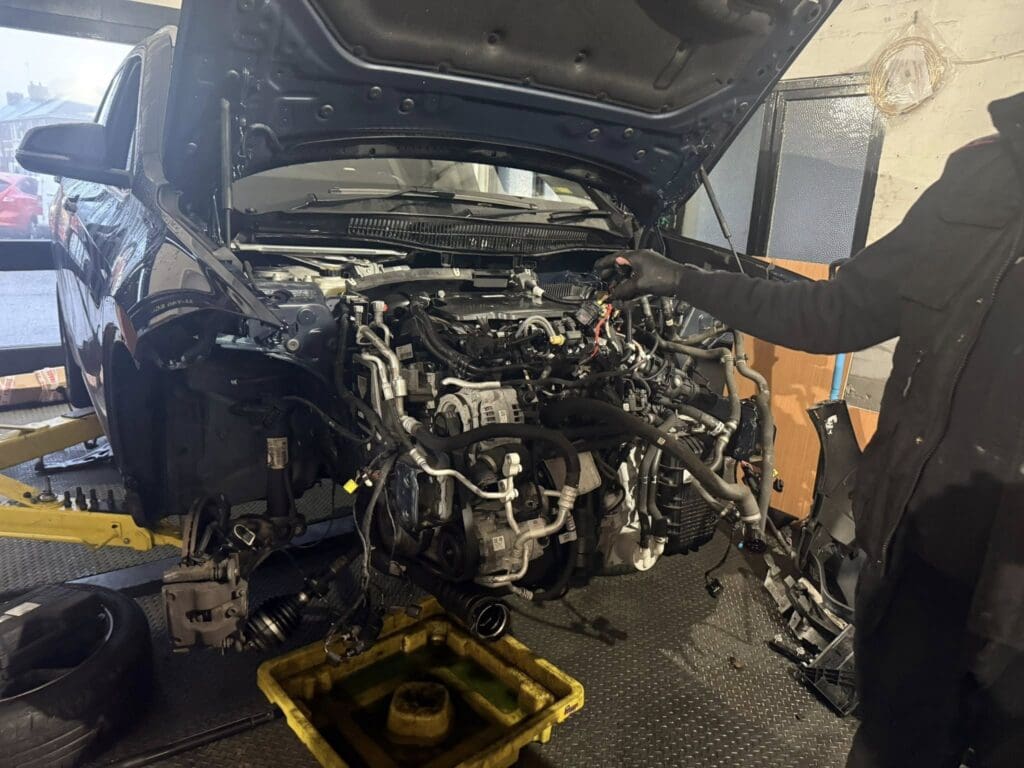
We recently had a 2019 BMW X1 in with a clogged DPF. The owner noticed the performance dropping off and the car started showing the usual DPF symptoms. What made this job stand out was not the cleaning process itself. It was the access.
On this car, the DPF sits in a location that can make proper removal extremely time-heavy. In some cases, the only correct route involves far more disassembly than owners expect. This is why we always start with facts, not assumptions.
In this post, we explain:
- How a DPF blocks in the first place
- Why “forced regens” and quick fixes often fail
- When engine-out access becomes the sensible option
- Why you must fix the cause of the soot, not just clean the filter
- What we did on this BMW X1 and what you can learn from it

DPF Warning on a BMW? Get the Cause Diagnosed Before You Pay Twice
A DPF does not block for no reason. If you clean it without fixing the cause, it will often block again.
At Star Garage Mansfield, we start with proper diagnostics to confirm why the DPF loaded up in the first place. Then we advise the best route to get it back to full health.
Where removal and cleaning is the right option, we carry out off-vehicle DPF cleaning so the filter can be properly restored, dried, and tested rather than guessed.
Based in Mansfield, we help drivers avoid repeat DPF bills by dealing with the root fault as well as the filter.
What a DPF Actually Does and Why It Blocks
A Diesel Particulate Filter (DPF) traps soot particles from the exhaust. This keeps emissions down and helps the car meet modern regulations. Over time, the filter fills with soot. That part is normal.
To stop it clogging, the vehicle runs a regeneration cycle. During a regen, the exhaust temperature rises and burns soot into ash. The ash remains, but much more slowly than soot builds. In a healthy system, the car clears soot regularly and you never notice it.
The problem starts when the car cannot complete regeneration properly, or when the engine produces far more soot than it should.
Common reasons a DPF blocks include:
- Short journeys that never let the exhaust get hot enough
- Repeated interrupted regens due to stop-start driving
- Boost leaks that cause poor combustion and extra soot
- EGR issues that upset air and fuel balance
- Faulty sensors such as differential pressure or temperature sensors
- Injector problems causing over-fuelling and smoke
- Turbo issues leading to under-boost and heavy soot output
So when someone says “my DPF is blocked”, the real question is:
Is it blocked because of driving pattern, or because the engine is creating abnormal soot?
Signs Your BMW DPF Is Blocking
Drivers usually notice a pattern before the car becomes undriveable.
Typical symptoms include:
- DPF warning light on the dash
- Reduced power or limp mode
- Poor fuel economy and more frequent fans running
- Strong exhaust smell during attempted regens
- Rougher running during idle on regen attempts
- Repeated “regeneration” messages (varies by model)
If you keep driving while the filter loads up, the backpressure rises. That can put stress on the turbo and raise exhaust temperatures in ways you do not want.
This is why early action matters. Not because of the light itself, but because of what the restriction does to the rest of the engine.
Why “Quick Fix” DPF Treatments Often Waste Linking Opportunity
We see many cars arrive after the owner has tried:
- DPF cleaning additives in the fuel
- Spray-in “DPF cleaner” products
- A forced regen at another garage, with no deeper checks
- Repeated motorway runs with the light already on
These routes can help in very mild cases, but they often fail for one main reason.
They do not fix why the DPF loaded up.
If the engine is producing excess soot because of a boost leak, sensor fault, EGR issue, or fuelling problem, you can clean the DPF today and it will start clogging again straight away.
It becomes a loop:
- DPF blocks
- Car attempts regen and fails
- Owner tries an additive or a forced regen
- Light clears for a short time
- DPF blocks again because the cause remains
That is why we prefer a proper test-led approach. It protects your wallet and it protects the engine.
Why Some Modern BMW DPF Jobs Need Engine-Out Access
On paper, a DPF is just an exhaust component. In practice, packaging on modern engines can be tight.
Manufacturers chase:
- Faster warm-up for emissions compliance
- Compact engine bays
- More sensors, more heat shielding, more components
That often means the DPF sits close to the turbo and is buried behind other parts. You can only remove it by moving what sits in the way.
On some vehicles, you might squeeze it out with subframe drops or major strip-down. On others, an engine-out approach can be the cleanest way to do the job without forcing parts, damaging fixings, or rushing the process.
This is not “making work”. It is choosing the safest route for the car when access is the real challenge.
If you are reading this and thinking, “That sounds extreme”, ask yourself:
Would you rather someone fight the job and risk damaging things, or remove access properly and do it once?
The Job: 2019 BMW X1 With a Clogged DPF
This BMW X1 came in with a clogged DPF and the usual running symptoms that go with it.
Step one was not “clean it”. Step one was to confirm what the car was seeing and why.
We started with a full diagnostic approach:
- Scan for stored and pending fault codes
- Check soot loading and regeneration history
- Review live data for boost control, air mass, and related sensor plausibility
- Assess whether the car had attempted regens and failed
This matters because there are two very different scenarios:
- Scenario A: DPF blocked mostly due to use pattern, with no engine faults
- Scenario B: DPF blocked due to a running issue that is creating abnormal soot
On this car, the evidence pointed to the second scenario.
The Hidden Cause: A Split Boost Pipe
Once access work began, we found the cause that mattered most.
The engine had a split boost pipe.
This type of fault can create a chain reaction:
- Boost leak reduces air charge
- Combustion becomes less efficient
- More soot forms under load
- DPF fills faster than it can clear
- Regens may fail more often
- Backpressure rises and performance drops further
Drivers often describe it as “it feels like it has no pull” or “it’s gone flat”. Sometimes you also see more smoke under acceleration, but not always in an obvious way.
The key point is simple.
If we had only cleaned the DPF and left the boost leak, the DPF would have started blocking again.
So we replaced the split boost pipe as part of the repair plan.
Off-Vehicle DPF Cleaning: What “Proper” Looks Like
Once the cause was addressed, we cleaned the DPF properly off the vehicle.
Off-vehicle cleaning matters because it lets you restore the filter without relying on guesswork. You are not hoping a chemical treatment dissolves the right deposits in the right place. You are removing the DPF, cleaning it, and drying it correctly.
A proper off-vehicle process aims to:
- Remove soot and ash build-up from the filter core
- Restore airflow and reduce backpressure
- Allow the vehicle to regenerate normally again
- Prevent repeated limp mode events
When the DPF is back to a healthy state, the vehicle can manage soot loads in the way it was designed to.
This is why our DPF work ties closely into our diagnostics service. Cleaning without diagnosis often becomes repeat business for the wrong reason.
Why We Fix the Cause First, Not Last
Many owners ask, “Can you just clean it first?”
We understand why. You want the cheapest and quickest route back on the road.
But fixing the cause first protects you from:
- Paying for a clean twice
- Returning with the same DPF warning in a few weeks
- Risking turbo stress from repeated high backpressure
- Masking a running issue that grows into a bigger repair
That is why we treat DPF work as a system job. Exhaust aftertreatment only works if the engine runs cleanly.
What You Can Do to Reduce DPF Blockage Risk
Not all DPF issues come from mechanical faults. Driving pattern matters too.
If you mainly do short trips, consider:
- One longer run each week where the engine fully warms up
- Avoid switching off mid-regeneration if you can help it
- Keeping on top of servicing and oil quality
- Acting early when a warning appears, before it becomes a restriction problem
But remember.
If you have a boost leak, sensor fault, or fuelling issue, no amount of “Italian tune-up” driving will fix it. You need diagnosis and repair.
Is Your BMW DPF Problem Linked to Other Faults?
On BMW diesels, the DPF system interacts with several areas:
- Boost control and intake system integrity
- EGR operation and air mass readings
- Exhaust temperature management
- Differential pressure readings across the filter
If one piece goes out of range, the rest of the system suffers.
That is why a DPF warning should trigger one question in your mind:
What changed before the light came on?
Power drop, smoke, new noises, harsh running, more frequent fan runs, higher fuel use. These clues matter.
DPF Cleaning in Mansfield: When to Book In
Book in for a check if you have:
- A DPF light that stays on
- Limp mode linked to emissions faults
- Repeated regens and no clear improvement
- Smoke under load that is not normal for your car
- A history of short runs and now the warning has started
If you want a clear route to fix it properly, start with diagnostics. If cleaning is the right next step, we can carry out off-vehicle DPF cleaning and make sure the cause is addressed at the same time.
Related Reading
If you want more context around DPF symptoms and why diagnosis matters, these guides may help:
- DPF Cleaning Near Me Guide
- DPF Cleaning Mansfield: Diagnose First, Clean Right
- What Are the Signs of a Blocked DPF?
Book a DPF Diagnosis and Cleaning at Star Garage Mansfield
A blocked DPF on a BMW X1 is not just a filter problem. It is often a symptom of a running fault that needs fixing.
At Star Garage Mansfield, we start with a proper diagnostic check, then advise whether you need a repair, a clean, or both.
Where removal is needed, we offer off-vehicle DPF cleaning to restore the filter correctly rather than relying on short-term fixes.
We are based in Mansfield. If your BMW has a DPF warning, limp mode, or unexplained smoke, book in and get clear answers.
Contact Star Garage Mansfield today to get booked in.
Call 01623 904724
Star Garage Mansfield, 2 Warsop Road, Mansfield Woodhouse, NG19 9LF
Monday–Friday: 8:00 AM–5:30 PM | Saturday: 8:00 AM–1:00 PM | Sunday: Closed
Need this looked at?
Describe the symptom and we’ll tell you whether it needs a diagnostic slot or a straight booking.
- 5.0 from 235 Google reviews
- Mon–Fri 08:30–18:00
- 2 Warsop Road, Mansfield Woodhouse