By Luke Sherwood, Senior Technician at Star Garage Mansfield • Published 22 September 2026 • Updated 22 September 2026
A wet belt sounds like a minor engineering footnote until it destroys an engine. We’ve removed blocked oil strainers packed with rubber crumbs from failed wet belts, and we’ve seen the aftermath when a driver ignored the oil pressure light for thirty more seconds. This guide gives you the full UK list and explains what it actually means for your car.
What Is a Wet Belt Engine?
A wet belt — also called a belt-in-oil (BIO) system — is a timing belt that runs inside the engine submerged in oil rather than in a sealed dry housing away from lubricants. The idea was sound: lubrication would reduce friction, lower CO₂ emissions and quieten the engine, potentially extending the belt’s service life.
In practice, real-world heat cycles, fuel contamination and degraded oil chemistry have caused belts to fail far earlier than the early manufacturer claims suggested. Stellantis originally marketed intervals of up to 10 years or 150,000 miles for the PureTech. They have since cut the official replacement interval to 6 years or 62,000 miles, according to Honest John’s 2026 wet belt guide. Ford’s guidance for the 1.0 EcoBoost has settled at 7–8 years or 80,000 miles.
If your car is on the list below, knowing this is the single most important maintenance fact about your vehicle.
Full UK List: Which Cars Have Wet Belt Engines?
Ford — EcoBoost Petrol
The Ford 1.0 EcoBoost (Fox engine, 2012–2019) and 1.5 EcoBoost three-cylinder Dragon engine both use wet belts. Affected models include:
- Ford Fiesta — 1.0 EcoBoost (2013–2019)
- Ford Focus — 1.0 & 1.5 EcoBoost (2012–2019)
- Ford Mondeo — 1.0 & 1.5 EcoBoost (2014–2022)
- Ford Puma — 1.0 EcoBoost (2019–2020)
- Ford Kuga — 1.5 EcoBoost (2016–2019)
- Ford Transit Connect & Transit Courier — 1.0 EcoBoost (2013–present)
Note: Most Ford 1.0L mild-hybrid (MHEV) models from late 2019 onwards switched to a timing chain. The 1.5 EcoBoost four-cylinder (2014–2018) uses a traditional dry belt — the wet belt applies to the three-cylinder Dragon variant only.
We cover the specific failure pattern on Ford EcoBoost engines in detail in our Ford EcoBoost oil pressure and wet belt case study.
Ford — EcoBlue Diesel
- Ford Kuga, Focus, Mondeo, S-MAX, Galaxy — 2.0 EcoBlue Diesel (2016–present)
- Ford Ranger, Transit, Transit Custom — 2.0 EcoBlue Diesel (2016–present)
- Ford Transit Connect — 1.5 EcoBlue Diesel (2013–present)

Stellantis — Peugeot PureTech 1.2
- Peugeot 208 — 1.2 PureTech (2014–2023)
- Peugeot 2008 — 1.2 PureTech (2014–2023)
- Peugeot 308 — 1.2 PureTech (2014–2023)
- Peugeot 3008 — 1.2 PureTech (2014–2023)
- Peugeot 5008 — 1.2 PureTech (2014–2023)
The 2023+ Gen 3 PureTech mild-hybrid variants have switched to a timing chain. If your Peugeot is 110 or 130PS without hybrid assistance, it almost certainly has a wet belt.
See our Peugeot 3008 wet belt replacement case study for what the job actually involves.
Stellantis — Citroën PureTech 1.2
- Citroën C3 — 1.2 PureTech (2014–2023)
- Citroën C3 Aircross — 1.2 PureTech (2014–2023)
- Citroën C4 & C4 Cactus — 1.2 PureTech (2014–2023)
- Citroën Berlingo — 1.2 PureTech (2014–2023)
Stellantis — DS Models
- DS 3 — 1.2 PureTech (2015–2023)
- DS 7 — 1.2 PureTech (2015–2023)
Stellantis — Vauxhall PureTech 1.2
- Vauxhall Corsa — 1.2 PureTech (2019–2023)
- Vauxhall Mokka — 1.2 PureTech (2019–2023)
- Vauxhall Crossland — 1.2 PureTech (2019–2023)
- Vauxhall Grandland — 1.2 PureTech (2019–2023)
Honda
- Honda Civic — 1.0L VTEC Turbo (2017–2021)
The 1.5L Turbo Civic uses a timing chain. The 1.0L VTEC Turbo is the specific wet belt variant.
Many VW Group 1.6 and 2.0 TDI engines (Audi A3/A4, VW Golf/Passat/Tiguan, SEAT, Skoda) and Volvo SPA-platform models use a smaller oil pump belt which runs in oil, but this is not the main timing belt. This is generally lower risk than a full belt-in-oil timing system. Check your specific engine to confirm whether a timing belt or chain handles valve timing.
Why Wet Belts Fail — and What We’ve Actually Seen
The theory behind wet belt design was that the oil bath would extend belt life indefinitely. The real-world failure mode is more specific, and it kills engines quickly when it happens.
As a wet belt degrades — whether from old oil, fuel contamination or heat cycles — it begins shedding small rubber particles into the engine oil. These particles are light enough to be carried by oil flow until they reach the oil pickup strainer at the bottom of the engine. The strainer’s job is to filter debris before the oil pump draws fluid from the sump. As rubber crumbs accumulate, the strainer becomes restricted.
Here is the critical point: the engine still has oil in it. What it no longer has is adequate oil pressure. The oil pump cannot draw enough fluid through the blocked strainer to circulate lubrication around the engine. Oil pressure drops, the warning light flickers, and if the engine is not stopped immediately, the bearings run dry and seize — usually within seconds.
We documented exactly this failure pattern on a Ford Ka that came to us with a low oil pressure warning light. The strainer was entirely blocked with rubber crumb debris from the degraded wet belt — see the Ford Ka oil strainer case study for photographs of what this looks like in practice. The oil level was normal. The pressure was effectively zero.

This is why timing belt and chain service on a wet belt engine is not the same as a routine cambelt change. The oil pickup strainer needs to be inspected at every belt change, and the oil specification must match the manufacturer’s requirement exactly — not a generic equivalent.
Warning Signs Your Wet Belt Is Starting to Fail
🔴 Low Oil Pressure Warning
The most urgent sign. Even a single flicker means stop the car immediately. Do not drive to the next junction. Continuing to run the engine risks a full seizure in seconds.
⚙️ Engine Limp Mode
If the belt stretches or loses teeth, timing slips. The ECU detects the cam-to-crank discrepancy and puts the engine into limp mode to prevent catastrophic damage.
🔦 Visible Cracking or Swelling
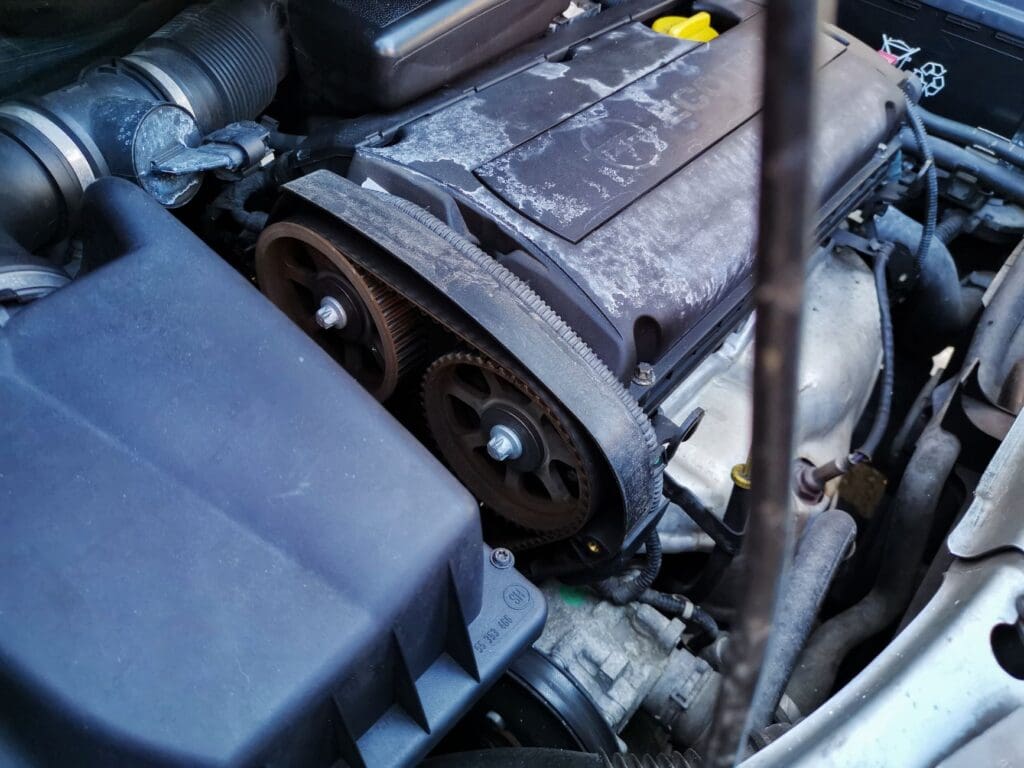
On some engines (particularly the PureTech) you can see the belt by removing the oil filler cap. Cracks, fraying or a belt that looks wider than it should are immediate warning signs.
🛢️ Black Grit in the Oil Filter
Ask your mechanic to cut open the old oil filter at every service on a wet belt engine. Black rubber grit in the filter media is the earliest physical sign that the belt is beginning to degrade.
Service Intervals: What Manufacturers Now Recommend
| Engine | Original Claim | Current Recommendation (2026) |
|---|---|---|
| Stellantis 1.2 PureTech | Up to 150,000 miles / 10 years | 6 years or 62,000 miles |
| Ford 1.0 EcoBoost | 10 years / 150,000 miles | 7–8 years or 80,000 miles |
| Ford 2.0 EcoBlue Diesel | Varies | 6 years or 100,000 miles |
| Honda 1.0 VTEC Turbo | 10 years | 5 years (Honda recall guidance) |
We recommend acting at the lower mileage threshold rather than waiting for the calendar deadline — especially on second-hand cars where service history is incomplete. If you are buying used and the car is over five years old with no belt change evidence, budget for the job immediately.
Unlike a standard dry belt, a wet belt change is a more involved job because the sump often needs to come off to inspect and clean the oil pickup strainer. That is not something every garage includes in the work. Always confirm it is part of the quote.
Got a wet belt engine? Book a check at Star Garage Mansfield
We service wet belt engines across Mansfield Woodhouse, Kirkby-in-Ashfield, Kirkby, Sutton-in-Ashfield and the surrounding Nottinghamshire area. If your car is on the list above and the history is unclear, come in — we will inspect the belt, check the oil filter for debris and advise you honestly on timing.
Frequently Asked Questions
How do I know if my car has a wet belt?
Check the brand and engine code against the list above. For Ford, you’re looking at 1.0 EcoBoost engines built before late 2019 and 2.0 EcoBlue diesels. For Peugeot, Citroën, DS and Vauxhall, any 1.2 PureTech without a mild-hybrid badge built before 2023. If in doubt, a mechanic can confirm by looking at the cam cover — a wet belt engine has the timing belt enclosed within the oil-wetted side of the engine rather than behind a separate dry cover.
What happens if a wet belt fails?
There are two failure routes. First, the belt snaps: pistons hit valves, causing immediate catastrophic engine damage that usually requires a full replacement. Second, and more commonly, the belt delaminates — shedding rubber crumbs into the oil that clog the oil pickup strainer. Oil pressure drops to near zero, bearings run dry, and the engine seizes. The second failure mode can happen even when the belt looks intact, which is why visible belt condition alone is not a reliable check.
How much does a wet belt replacement cost?
Expect to pay priced on inspection at an independent garage for a full wet belt replacement on a Stellantis PureTech or Ford EcoBoost, including the oil pickup strainer inspection and clean. Main dealer prices can exceed priced on inspection. The job is significantly more involved than a standard dry cambelt change because it requires dropping the sump on most engines. Do not accept a quote that does not include the strainer check.
My car has a wet belt but seems fine — should I still replace it?
Yes. The problem is that wet belt degradation is not visible from outside the engine, and by the time a symptom appears it is usually already causing damage to the strainer. A belt that feels fine can be shredding rubber into the oil for months before any warning light triggers. The only reliable protection is proactive replacement at or before the revised service interval.
Need this looked at?
Describe the symptom and we’ll tell you whether it needs a diagnostic slot or a straight booking.
- 5.0 from 235 Google reviews
- Mon–Fri 08:30–18:00
- 2 Warsop Road, Mansfield Woodhouse