
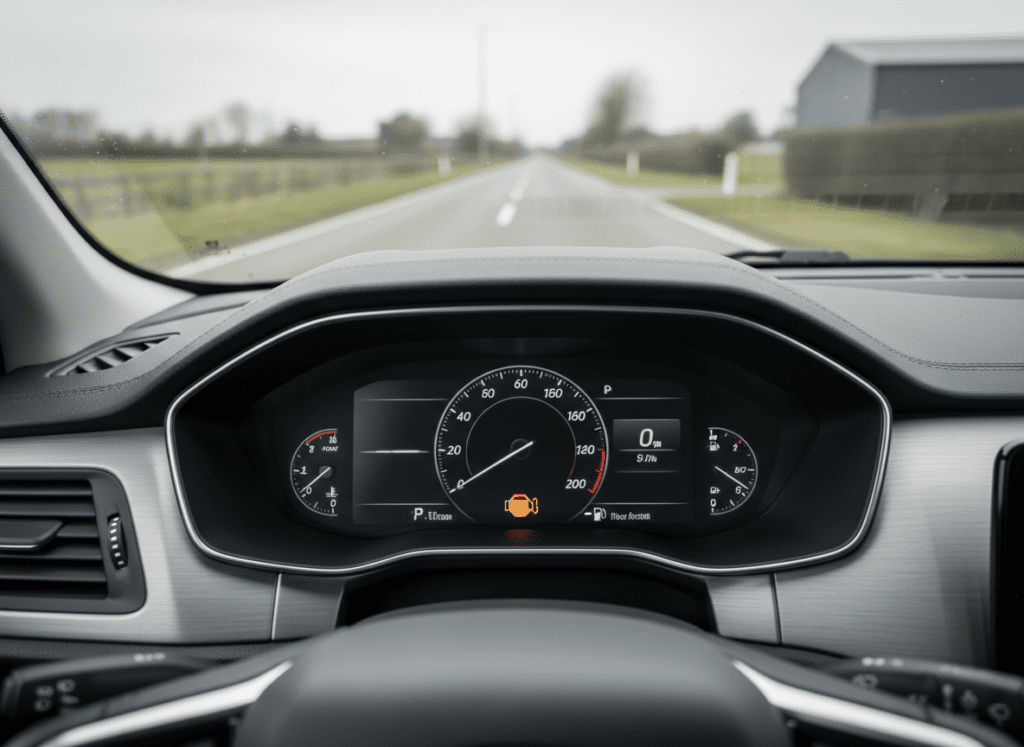
The engine management light comes on. The car feels completely normal — no strange noises, no loss of power, no warning from the road. It is tempting to assume it is nothing serious and carry on driving.
This is one of the most common situations we see at Star Garage Mansfield.
A steady engine management light with no obvious symptoms does not mean the fault is minor. It often means the fault is in its early stage — before the car gives you any physical warning at all.
This guide explains what the light actually monitors, what the most common causes are when the car still drives fine, when it becomes urgent, and what proper diagnosis involves.
- Quick answer: should you keep driving?
- What the engine management light actually monitors
- Why the car can still drive normally
- Common causes when the car seems fine
- When the light becomes urgent
- What happens if you keep ignoring it
- How we diagnose engine management lights
- Cost comparison: early vs late diagnosis
- Frequently asked questions
If your engine management light is on but the car drives normally, you should not ignore it. Short-term driving is generally possible, but the fault needs diagnosing soon. A steady light without symptoms often signals an early-stage fault — and early diagnosis is significantly cheaper than waiting until the car forces the issue.
The engine management light — sometimes called the EML, check engine light, or MIL (malfunction indicator lamp) — is triggered by your car’s ECU (engine control unit) when a sensor reading falls outside its expected range.
The ECU monitors an enormous range of systems simultaneously, including:
- Airflow and boost pressure from the intake
- Fuel injection timing and fuel trim
- Exhaust emissions — oxygen sensors, lambda sensors
- EGR (exhaust gas recirculation) valve operation
- DPF (diesel particulate filter) soot load and pressure differential
- Throttle position and pedal response
- Camshaft and crankshaft correlation (timing)
- Catalytic converter efficiency
When any of these readings drift outside the acceptable window — even slightly — the ECU logs a fault code and illuminates the light. It does not mean the car has broken down. It means the ECU has noticed something it wants a technician to look at.
That is an important distinction. The light is a notification, not a verdict.
Why the Car Can Still Drive Normally
Modern ECUs are designed to compensate for minor faults. This is by design — manufacturers want vehicles to remain driveable even when small issues develop, rather than failing immediately.
For example:
- A slightly drifting MAF (mass airflow) sensor can be partially corrected by fuel trim adjustments
- Early EGR valve sticking may not yet affect throttle response or power delivery
- A rising DPF soot load will trigger a warning well before limp mode activates
- Minor boost leaks can exist before they are large enough to cause noticeable hesitation
- Lambda sensor degradation often happens gradually, logging a fault long before fuelling becomes obviously wrong
The ECU catches these issues early — often before you feel any change in how the car drives. That is actually useful. It gives you a window to diagnose and fix the problem at a lower cost and lower complexity than if the fault had worsened undetected.
The danger is assuming that because the car drives fine, the light can wait indefinitely.
Common Causes When the Car Still Seems Fine
1. Mass Airflow (MAF) Sensor Drift
The MAF sensor measures the volume of air entering the engine. When it reads inaccurately, the ECU adjusts fuelling to compensate — and logs a fault. Early MAF faults rarely produce noticeable symptoms because the ECU manages the discrepancy. Over time, however, the compensation range runs out and drivability deteriorates.
2. Oxygen or Lambda Sensor Faults
Lambda sensors monitor exhaust gas composition and feed real-time data to the ECU for fuel mixture control. A lazy or failing sensor will often cause a fault code before it produces any obvious fuelling problem. These sensors degrade over time and are commonly found at fault when the car still feels perfectly normal to drive.
3. EGR Valve Issues
The EGR valve recirculates a portion of exhaust gas back into the intake to reduce emissions. When it starts sticking or responding slowly, the ECU logs the fault but the car often continues to drive without any change. Left unchecked, a faulty EGR can cause carbon build-up, rough running, and eventually limp mode.
4. Early DPF Restriction (Diesel Vehicles)
On diesel vehicles, the DPF system monitors soot accumulation and exhaust backpressure. A rising soot load will trigger the warning light before limp mode activates — giving drivers an early signal that a regeneration cycle is needed. Continuing to drive short journeys without allowing regeneration to complete will cause the soot load to rise further.
See our guide on common diesel faults for related issues.
5. Minor Boost or Vacuum Leaks
Small cracks or loose connections in boost hoses or vacuum lines can trigger airflow discrepancies logged by the ECU. The engine often compensates well enough that no power loss is immediately obvious — but the fault is present and worsening with heat cycles.
6. Subtle Timing Drift
On engines with variable valve timing or cam-crank correlation monitoring, early timing chain wear or VVT solenoid faults can produce fault codes before any noise or drivability change appears. If you have noticed a brief cold-start rattle alongside the light, visit our page on timing chain services for more detail.
7. Purge Valve or EVAP System Faults
The evaporative emissions system (EVAP) prevents fuel vapour from entering the atmosphere. Faults with the purge valve or EVAP canister are common causes of the engine management light in cars that otherwise drive perfectly normally. These are often triggered by something as simple as a loose fuel cap — worth checking before booking a full diagnostic.
When the Light Becomes Urgent
A steady engine management light with normal driving behaviour is typically not an immediate emergency — but there are situations that require prompt attention:
- The light is flashing or blinking — this usually indicates an active misfire that can damage the catalytic converter and DPF
- A second warning light has come on alongside the EML
- You notice any change in power, acceleration, or fuel consumption
- The car has entered limp mode (limited power, restricted revs)
- You smell burning, fuel, or unusual exhaust odour
- The light came on immediately after refuelling, a long motorway run, or a cold start
A flashing engine management light is a categorically different situation to a steady one. It indicates a severe or active fault — typically a misfire — where unburnt fuel is entering the exhaust. This can destroy a catalytic converter within a short period of continued driving.
What Happens If You Keep Ignoring It
The engine management light exists because the ECU wants the fault investigated. Ignoring it does not make the fault go away — it allows it to progress.
Here is how typical fault progressions work:
| Early Stage | If Left | Likely Outcome |
|---|---|---|
| MAF sensor drift | Worsening fuelling, rough idle | Failed MOT emissions, poor MPG |
| EGR sticking early | Carbon build-up in intake | Expensive intake clean or EGR replacement |
| Rising DPF soot load | Limp mode, blocked DPF | Professional DPF clean or replacement |
| Lambda sensor degrading | Poor fuelling, failed emissions | Catalytic converter damage |
| Boost hose leak | Power loss, turbo strain | Turbocharger damage |
In most cases, catching the fault at the first warning stage results in a significantly lower repair cost than waiting for the secondary or tertiary symptom to force action.
How We Diagnose Engine Management Lights at Star Garage Mansfield
Our diagnostic process does not stop at reading the fault code. A fault code tells us which sensor or system has reported a problem — it does not always tell us the root cause.
Our approach includes:
- Full system scan — reading all stored and pending fault codes across every module
- Live data analysis — reviewing actual sensor readings under load conditions, not just idle
- Freeze frame data — examining the conditions present when the fault was first logged
- Component testing — testing the suspect component directly before recommending replacement
- Road test under load — where the fault only appears under specific driving conditions
We confirm the cause before recommending any repair. We do not replace parts on assumption.
Cost Comparison: Early vs Late Diagnosis
| Fault | Cost if Left |
|---|---|
| MAF sensor fault | Priced per vehicle |
| DPF warning (early soot) | Full DPF replacement: priced on inspection |
| EGR valve fault | Priced per vehicle |
| Lambda sensor | Catalytic converter damage: priced on inspection |
| Boost leak | Turbocharger damage: priced on inspection |
In every case, the early-stage repair is a fraction of the cost of the fault allowed to escalate. The engine management light is the earliest warning you get — it is worth acting on it.
Engine Management Light On in Mansfield?
If your warning light is on — even if the car feels normal — do not assume it can wait. Book a diagnostic inspection at Star Garage Mansfield and we will confirm the cause before recommending any repair.
Call 01623 904724 or use the links below.
Frequently Asked Questions
Can I keep driving with the engine management light on?
If the light is steady and the car drives normally, short-term driving is usually possible. However, the fault should be diagnosed promptly. A flashing light is a different situation — it requires stopping driving and booking an inspection as soon as possible.
What does a flashing engine management light mean?
A flashing EML typically indicates an active engine misfire. This can cause rapid damage to the catalytic converter and DPF. You should reduce speed, avoid heavy acceleration, and book an inspection as soon as possible.
Will the engine management light go off by itself?
It may clear temporarily if the fault is intermittent, but the root cause remains. Codes that clear without a fix often return. Clearing the code without diagnosing the fault does not solve the problem.
Is it worth using an OBD reader yourself before booking a garage?
A basic OBD reader can give you the fault code, which is useful context. However, the code points to the system affected — not necessarily the specific component at fault. Professional diagnosis involves live data and component testing, which a basic reader cannot provide.
How long does a diagnostic take?
A standard diagnostic scan and initial assessment typically takes 45–60 minutes. If the fault is intermittent or requires a road test to replicate, additional time may be needed. We will explain what we find and what we recommend before any repair work begins.
Need this looked at?
Describe the symptom and we’ll tell you whether it needs a diagnostic slot or a straight booking.
- 5.0 from 235 Google reviews
- Mon–Fri 08:30–18:00
- 2 Warsop Road, Mansfield Woodhouse


