
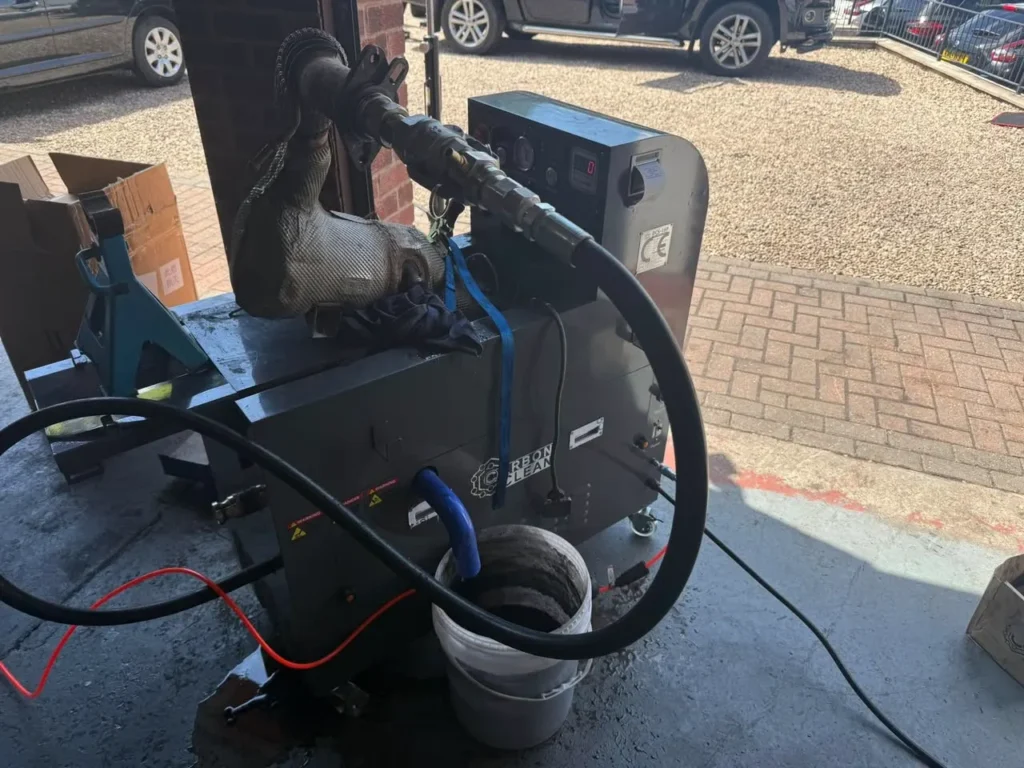
A 2019 Ford Transit Custom came into Star Garage Mansfield with signs of a severely blocked diesel particulate filter (DPF). Power was limited, warning lights were on, and the van was dangerously close to entering limp mode.
We carried out a full off-vehicle DPF industrial clean using our Carbon Clean machine — and it took three full buckets of carbon-laced fluid before it finally ran clear. Here’s what we did and how we saved this van from costly downtime.
The customer uses this van daily for work, often on short runs and urban routes — the exact conditions that cause DPFs to clog faster due to lack of regeneration.
With poor performance, a DPF warning light, and high backpressure readings, we recommended an off-vehicle industrial DPF clean to fully flush the soot and ash from deep inside the filter.
Signs Your Transit Custom’s DPF Is Blocking
This van arrived with obvious symptoms, but most of the Transit Customs we see start showing much quieter warnings first. In the workshop the pattern is usually the same order:
- Fuel economy quietly drops off on routes the driver knows well
- The exhaust filter or DPF warning light appears, often with a dashboard message asking the driver to keep driving to clean the filter
- The engine management light joins it
- Power tails off, then the van drops into limp mode and the job stops
The important point is that the earlier stages are recoverable. Once a filter has loaded with ash to the point where the van will no longer regenerate on its own, no amount of motorway driving will clear it — it needs to come off the vehicle.
Why Transit Custom DPFs Block Up
Almost every blocked filter we take off a Transit Custom comes down to the same thing: the van never gets the chance to finish a regeneration. Vans on short urban runs, multi-drop routes and stop-start delivery work rarely hold the exhaust temperature long enough to burn the soot off, and every trip that ends mid-cycle leaves more behind than it clears.
Faults elsewhere in the system do the same job. A regeneration that cannot raise exhaust temperature properly, or a temperature sensor feeding the ECU the wrong picture, will keep failing quietly in the background while the filter fills. That is why we take pressure readings and check the regeneration history before we touch anything — if the underlying fault is still there, a clean filter simply blocks again. We have written more about how DPF regeneration actually works if you want the detail.
What We Did
1. Removed the DPF from the exhaust system
We safely removed the filter and set it up on our Carbon Clean DCS-16P unit for a full chemical and pressure flush.
2. Carried out fluid soak and high-pressure rinse
We filled and soaked the filter with specialist DPF cleaning solution, then flushed it with water and compressed air until clean. It took three full buckets of blackened waste fluid before the water ran clear.
3. Dried and refitted the DPF
After a full drying cycle, we refitted the DPF, cleared the fault codes, and ran post-clean diagnostics to confirm success.
Results
- ✅ DPF flow restored
- ✅ No warning lights
- ✅ Van running smooth and strong
- ✅ Customer back on the road the same day
This clean saved the customer the cost of a new DPF — and prevented engine damage or forced derate. Another example of why early action is the best move when DPF trouble strikes.
Clean, Replace, or Delete? What We Tell Van Owners
A blocked filter usually comes down to three options, and only two of them are real.
Cleaning is the first thing worth trying. An off-vehicle industrial clean puts the original filter back on the van, which is why we recommended it here — the customer kept the part he already owned and was back at work the same day.
Replacement is the fallback. If the substrate inside the filter is cracked or melted, no clean will fix it and the part has to be renewed.
Deleting the filter is not an option, and it is worth being blunt about why. MOT testers have had to check for the presence of a diesel particulate filter when they inspect a diesel exhaust since February 2014, and DVSA’s position is that a vehicle that needs a filter and doesn’t have one should fail its MOT. The penalty for driving without one is a fine of up to £1,000 for a car and up to £2,500 for a light goods vehicle — and a Transit Custom is a light goods vehicle. For a van that has to earn its keep, that is a poor trade against the cost of cleaning the filter properly.
One of the most satisfying moments?
Watching bucket after bucket of thick black fluid pour out — then finally seeing that clear rinse at the end.
DPF Blocked? Book a Clean Today
If your van is losing power or showing a DPF warning, book a full DPF clean with us. We’ll inspect, flush, and restore your filter — fast, safe, and effective.
Call 01623 904724 or contact us online to book your clean today.
Need this looked at?
Describe the symptom and we’ll tell you whether it needs a diagnostic slot or a straight booking.
- 5.0 from 235 Google reviews
- Mon–Fri 08:30–18:00
- 2 Warsop Road, Mansfield Woodhouse


