
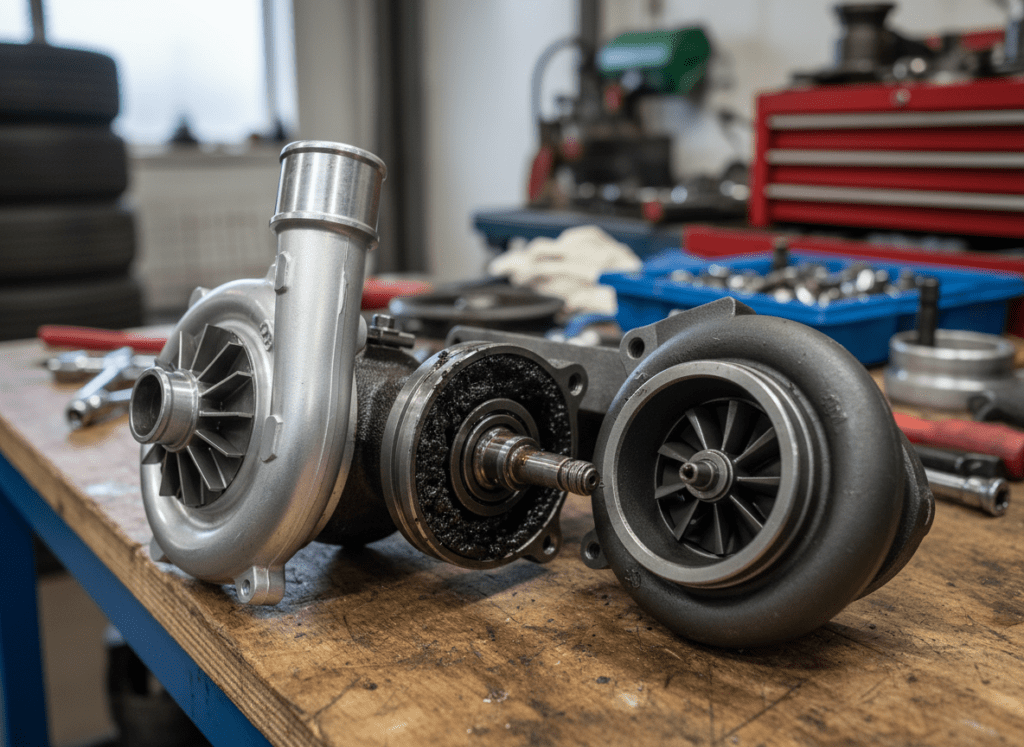
A failing turbocharger rarely gives up without warning. There are usually several signs before it stops working altogether — and the earlier you catch them, the cheaper the outcome. This guide explains what turbo failure symptoms look like, why they appear, and what to do when they do.
Quick Answer
The most common turbo failure symptoms are: grey or blue smoke from the exhaust, loss of power or sluggish acceleration, a high-pitched whining noise from the engine bay, oil consumption without visible leaks, and the engine management light coming on. If you notice one or more of these together, have your turbo inspected before the damage spreads.
Contents
How Turbochargers Fail
A turbocharger forces more air into the engine, allowing it to burn more fuel and produce more power from a smaller engine. It spins at speeds of up to 200,000 RPM, using exhaust gas energy to drive a compressor.
That level of mechanical stress means turbochargers have a finite lifespan. Most fail for one of three reasons: oil starvation, foreign object damage, or simply wear over time. Understanding how a turbo fails helps you recognise the symptoms before they become a breakdown.
Oil is everything for a turbo. The bearings that support the turbine shaft are lubricated by engine oil. If oil supply is poor — due to a blocked oil feed, oil that is too thick from cold starts, or low oil pressure — the bearings wear rapidly. This is the single most common cause of turbo failure in UK vehicles.
The Main Turbo Failure Symptoms
Turbo failure symptoms tend to develop gradually. You might notice one symptom early on, then others begin to appear as the problem progresses. Here is what to look and listen for.
Grey or Blue Exhaust Smoke
This is one of the clearest signs that a turbo is failing. When the seals on a turbocharger begin to break down, engine oil leaks into the exhaust stream and burns off as blue or grey smoke from the tailpipe.
You are most likely to notice this smoke on acceleration, when the turbo is working hard. A brief puff of blue smoke on cold start can sometimes be normal, but persistent smoke during driving — especially under load — points to a failing turbo seal.
Blue smoke more specifically indicates oil burning, which can also be caused by worn piston rings or valve stem seals. The difference is that if the smoke appears alongside other turbo symptoms, the turbo is the more likely source. A diagnostic scan and inspection will separate the two.
Loss of Power and Sluggish Acceleration
A turbocharger’s job is to pressurise the air entering your engine. If the turbo is struggling — due to worn bearings, shaft play, or a leaking seal — it cannot build boost pressure properly. The result is an engine that feels noticeably flat, particularly at higher revs.
Drivers often describe this as the car feeling like it is carrying extra weight, or that it used to pull much harder. Acceleration from a standstill is less responsive, and overtaking manoeuvres require more effort than before.
This loss of power is sometimes the first symptom you notice before any smoke or noise appears. It is easy to put down to fuel quality or weather, but if it persists or worsens, have the turbo and boost system inspected.
Turbo Lag vs Turbo Failure
It is worth distinguishing between normal turbo lag — a brief delay before boost builds — and genuine performance loss from a failing turbo. Normal lag happens in the lower rev range and resolves quickly as revs rise. A failing turbo produces power loss that does not improve as revs build, and often comes with one of the other symptoms described here.
Whining or Screeching Noises From the Engine
A healthy turbocharger is audible but not intrusive. If you start to hear a high-pitched whining, grinding, or screeching from the engine bay — particularly when the turbo is spooling under acceleration — something has gone wrong internally.
This noise usually comes from the bearings inside the turbo. As they wear, the turbine shaft develops play and begins to contact the housing. In early stages, you might hear a faint whine. As it progresses, the noise becomes louder and more consistent.
A grinding or rattling sound that comes specifically from the turbo area and changes with engine speed is a strong indicator that the turbo is approaching the end of its serviceable life.
Oil Consumption Without Visible Leaks
If you are regularly topping up your engine oil but cannot find any puddles under the car, the oil may be burning off through the turbo. Failed internal turbo seals allow oil to pass through the turbine housing and into the exhaust or intake system, where it burns without leaving an obvious external trace.
This is worth monitoring. Check your oil level regularly and note how frequently you need to top up. If you are adding more than half a litre between service intervals, that level of consumption warrants investigation.
Left unaddressed, the oil loss will eventually starve the turbo and other engine components of lubrication — accelerating wear across the whole top end of the engine.
Warning Lights and Fault Codes
Modern engines monitor boost pressure through sensors in the intake and exhaust system. If the turbo is not delivering the expected boost, or if the system detects an anomaly, the engine management light will typically illuminate.
Common fault codes associated with turbo problems include boost pressure sensor faults, overboost or underboost conditions, and wastegate or variable vane actuator codes. These codes alone do not confirm turbo failure — they confirm the boost system is outside its expected parameters and needs investigation.
If your engine management light is on and you are also experiencing power loss, smoke, or unusual noises, a turbo fault is a strong possibility. Book a diagnostic inspection so the fault codes can be read and interpreted in context of what the engine is actually doing.
What Happens If You Ignore Turbo Failure Symptoms
This is where the cost difference between early and late action becomes significant.
A turbo that is caught early — with mild bearing wear and intact seals — can often be rebuilt or replaced cleanly. The surrounding engine components are unaffected, and the repair is straightforward.
A turbo that is left to fail completely is a different situation. The turbine shaft can break apart under extreme stress. Fragments of metal are then ingested into the intake or exhaust side of the engine. In the worst cases, this causes internal engine damage: bent connecting rods, scored cylinder bores, and damaged pistons.
Even short of catastrophic failure, driving on a failing turbo damages the bearings further, contaminates the engine oil with metal particles, and can cause oil starvation in other engine components. The longer you leave it, the more the damage spreads.
Turbo Repair and Replacement Costs UK
| Repair Type | Notes |
|---|---|
| Turbo diagnostic inspection | Confirms fault before committing to repair |
| Turbo rebuild (bearings, seals) | Viable if housing and turbine intact |
| Turbo replacement (reconditioned) | Most common repair route |
| Turbo replacement (OEM new) | Typically for newer vehicles under warranty |
| Oil feed pipe replacement | Often done alongside turbo to prevent repeat failure |
| Engine repair after turbo failure | If debris caused internal damage |
How We Diagnose Turbo Problems at Star Garage Mansfield
We start with a full diagnostic scan to read live boost pressure data and any stored fault codes. Codes give us a starting point, but they do not replace a physical inspection of the turbo.
We check for shaft play by hand — a turbo with worn bearings will have noticeable movement in the turbine shaft. We inspect the intake and exhaust manifolds for oil deposits, check the oil feed pipe for restrictions, and review live boost data under load conditions.
This approach means we can tell you whether the turbo is on the way out, whether it can be rebuilt, or whether the symptoms are actually coming from a related system — a faulty MAP sensor, boost leak, or actuator fault — rather than the turbo itself. We see the same faults regularly on cars booked in by Chesterfield drivers who would rather travel for a proper diagnosis.
We always explain what we found before any work begins. If the turbo needs replacing, we will give you a clear cost and confirm what else needs attention alongside it. Our general repairs team handles turbocharger work on a wide range of makes and models.
Preventing Turbo Failure
Most turbo failures are not random — they are the result of preventable issues building up over time. These steps help protect your turbocharger:
- Change your oil regularly: Fresh, clean oil is the single most important factor in turbo longevity. Follow your manufacturer’s service intervals — or go shorter if you do a lot of short journeys.
- Let the engine warm up gently: Turbos are oil-deprived on a cold start. Avoid high revs or heavy loads until the engine has reached operating temperature.
- Let the engine idle before switching off: After a hard drive, idling for 30–60 seconds allows the turbo to cool before oil circulation stops. This prevents oil cooking on the bearings.
- Use the correct oil grade: Low-viscosity oils specified for your engine are correct for your turbo. Using the wrong grade causes lubrication problems.
- Address warning lights promptly: Small faults — boost leaks, sensor drift, EGR issues — can cause the turbo to work harder than intended and accelerate wear.
Frequently Asked Questions
Can I drive with a failing turbo?
Short journeys at low loads are less risky, but driving on a failing turbo accelerates the damage every time you use boost. If you are experiencing multiple symptoms together — smoke, power loss, noise — we recommend getting it inspected within a few days rather than waiting.
How long does a turbo last?
With proper maintenance, most modern turbochargers should last 100,000 miles or more. Vehicles with infrequent oil changes or predominantly short-journey use tend to see turbos fail earlier — sometimes at 60,000–80,000 miles.
Will my car go into limp mode with a failing turbo?
Yes. If the boost pressure falls significantly below target, the ECU will activate limp mode to protect the engine. You will notice severely reduced power and the engine management light will be on. Do not continue driving in limp mode — have the car inspected promptly.
Is grey smoke always a turbo problem?
Not always. Grey or blue smoke can also come from worn piston rings or valve stem seals allowing oil into the combustion chamber. A diagnostic scan and physical inspection is the only reliable way to identify the source. The context — other symptoms, when the smoke appears — helps narrow it down.
Can a turbo be repaired rather than replaced?
In some cases, yes. If the turbine housing and compressor wheel are undamaged, a specialist rebuild of the bearings and seals is a viable option and costs less than a full replacement. We will advise on the best route after inspecting the unit.
Think Your Turbo Is Failing? Book a Diagnostic
We will scan the boost system, inspect the turbo physically, and give you a clear diagnosis before any work begins. Catching it early keeps costs down.
Located in Mansfield Woodhouse, Mansfield. Serving drivers across Mansfield, Worksop, Chesterfield, and Nottingham. Open Monday–Friday, 8:30 AM to 6:00 PM. Phone: 01623 904724
Need this looked at?
Describe the symptom and we’ll tell you whether it needs a diagnostic slot or a straight booking.
- 5.0 from 235 Google reviews
- Mon–Fri 08:30–18:00
- 2 Warsop Road, Mansfield Woodhouse


