
Oil leaks are common.
Correct diagnosis is not.
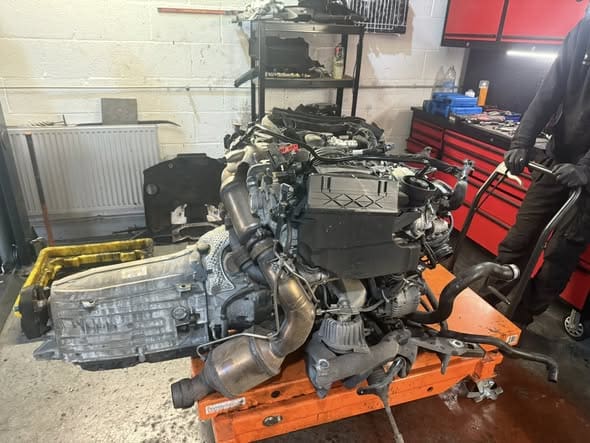
This 2011 Mercedes E350 Convertible arrived with visible oil leaks.
On many cars, that means seals, gaskets, or hoses.
On this one, access limitations changed everything.
The only way to diagnose the leaks properly was to remove the engine.
Anything less would have meant guessing.
The problem with guessing oil leaks
Oil travels.
Gravity, airflow, and heat move it far from its source.
Cleaning the outside of an engine and replacing the most obvious seal often hides the real fault.
On large engines, especially in tightly packed bays, visual inspection only goes so far.
This E350 had multiple potential leak points buried deep.
Replacing parts without full access risks:
- Missed leak sources.
- Repeat strip-downs.
- Customer frustration.
- Higher overall cost.
Diagnosis must come before repair.
Why engine removal was the right decision
The Mercedes E350 engine is physically large.
With the engine in place, there was no clear way to trace the leaks accurately.
The choice was simple.
Guess and hope.
Or remove the engine and know.
The customer agreed to an engine-out inspection.
That decision set the tone for the rest of the job.
This type of work falls under our
engine removal and engine work
service.
It is about access, not excess.
Engine out and stripped down
With the engine on the table, the investigation could begin properly.
Components were cleaned.
Surfaces were inspected.
Seals and housings were checked individually.
The source of the leaks became clear once everything was exposed.
There was not one fault.
There were several.
The leaks were traced to:
- A cracked oil cooler.
- The turbo oil supply area.
- The vacuum pump.
Any one of these could have been missed without full access.
Together, they explained the oil loss completely.
Why multiple leaks often appear together
Heat cycles harden seals.
Age affects plastic and aluminium housings.
Oil contamination spreads.
On engines like this, once one component starts to leak, others often follow.
Fixing only the most obvious point rarely solves the whole problem.
This is why full inspection matters.
You repair causes, not symptoms.
Additional work while the engine was out
Once the leaks were confirmed and the customer was informed, an additional request was made.
With the engine already removed, it made sense to replace the full timing chain kit at the same time.
Access was ideal.
Labour overlap reduced overall cost.
Future risk was lowered.
This is a practical approach.
It prevents paying twice for the same labour.
Timing-related work sits under our
timing chains and belts
service.
Combining jobs where it makes sense protects long-term reliability.
Repairing the leaks properly
Each leak source was repaired in turn.
Components were replaced or resealed correctly.
Gaskets and seals were renewed.
Surfaces were prepared properly.
This is where engine-out work pays off.
Clean access allows clean repairs.
Rushing this stage creates repeat failures.
Taking time prevents them.
Reassembly and refit
With repairs completed, reassembly began.
Every connection was checked.
Every fastener torqued correctly.
Every seal seated properly.
Once back in the vehicle, fluids were refilled and checks began.
- Oil pressure verified.
- Cooling system checked.
- Vacuum systems tested.
- Diagnostic scans completed.
Modern Mercedes engines demand both mechanical accuracy and electronic confirmation.
This is where our
car diagnostics
service supports engine work.
The result
Five days after the engine came out, the Mercedes was back together.
Oil leaks resolved.
Timing work completed.
No guesswork left behind.
The customer collected the car relieved.
Jobs like this test patience.
Doing them properly earns trust.
From routine servicing to complex engine-out repairs, the goal is the same.
Fix it once.
Fix it properly.
When engine-out diagnosis makes sense
Engine removal is not always required.
It becomes the right choice when:
- Leak sources cannot be confirmed in situ.
- Multiple components sit buried behind the engine.
- Previous repairs have failed.
- Access limits safe and accurate work.
In these cases, removing the engine often saves money overall.
It prevents repeat labour and unresolved faults.
Book diagnosis before repairs
Oil leaks should never be guessed.
They should be traced.
If your car is losing oil and previous fixes have not worked, start with diagnosis.
Use our
contact page
and tell us exactly what you are seeing.
Proper diagnosis turns difficult jobs into solvable ones.
This Mercedes is proof of that.
Need this looked at?
Describe the symptom and we’ll tell you whether it needs a diagnostic slot or a straight booking.
- 5.0 from 235 Google reviews
- Mon–Fri 08:30–18:00
- 2 Warsop Road, Mansfield Woodhouse