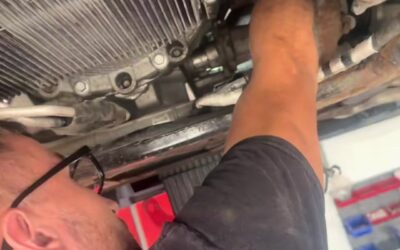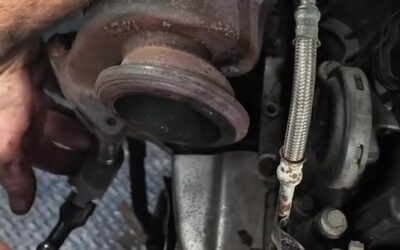
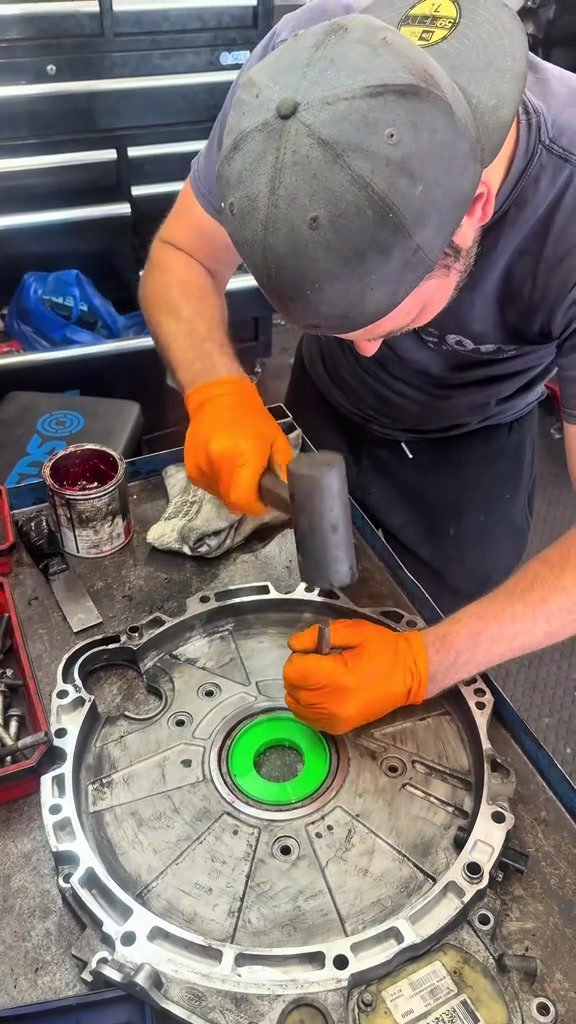
A rear main oil seal is a ring of rubber not much bigger than your palm. Replacing one on this Jaguar meant taking the gearbox off, removing the flywheel, pulling the timing chain casing and leaving fresh sealant to cure overnight. That is why a Jaguar rear main oil seal leak is never a quick job, and why it pays to be certain that is where the oil is coming from before anything is stripped. Here is how Dan did it.
Quick Answer
Watch the job:
What Came Into the Workshop
The car was a white Jaguar saloon, and it came to us with the rear main oil seal leaking. Dan, one of our technicians, filmed the repair from strip-down to handover, and the video above shows each stage.
We are not going to pad out the details of this particular car. What matters for anyone with a similar leak is the process: what has to come off, why, and what makes the difference between a seal that stays dry and one that starts weeping again a few months later.
What the Rear Main Oil Seal Actually Does
Your crankshaft runs the length of the engine and spins in a bath of oil. At the back, it has to pass out through the engine to drive the flywheel and gearbox. The rear main oil seal is the lip seal that lets the crankshaft spin while keeping the oil inside.
Over time, the rubber lip hardens, wears or loses its grip on the shaft. Oil then creeps past it and works its way out between the engine and the gearbox. Because the seal is buried, you almost never see it leaking directly. You see the results instead.
Typical signs of a rear main seal leak
- Oil dripping from where the engine meets the gearbox, often seen as a drip line from the bellhousing.
- Oil spots on the drive under the middle of the car rather than the front.
- Oil level dropping between services with no smoke and no other obvious leak.
- A burning oil smell if oil is reaching hot exhaust parts.
- An MOT advisory or failure for an oil leak.
Why the Gearbox Has to Come Off
The seal sits right at the back of the engine, directly behind the flywheel, and the gearbox bolts up against that. There is no way to reach it from above or below with everything in place. So the first half of the job is all about getting the gearbox out of the way.
The sequence Dan follows in the video:
- Remove the brackets and pipes off the gearbox so nothing is still attached when it moves.
- Undo the top bellhousing bolts — the awkward ones you cannot reach once the box is lowered.
- Drop the cradle to give the gearbox room to come back and down.
- Support the gearbox on a stand and pull it off the engine. A gearbox is heavy and has to come off straight, so this is not a job for a trolley jack and hope.
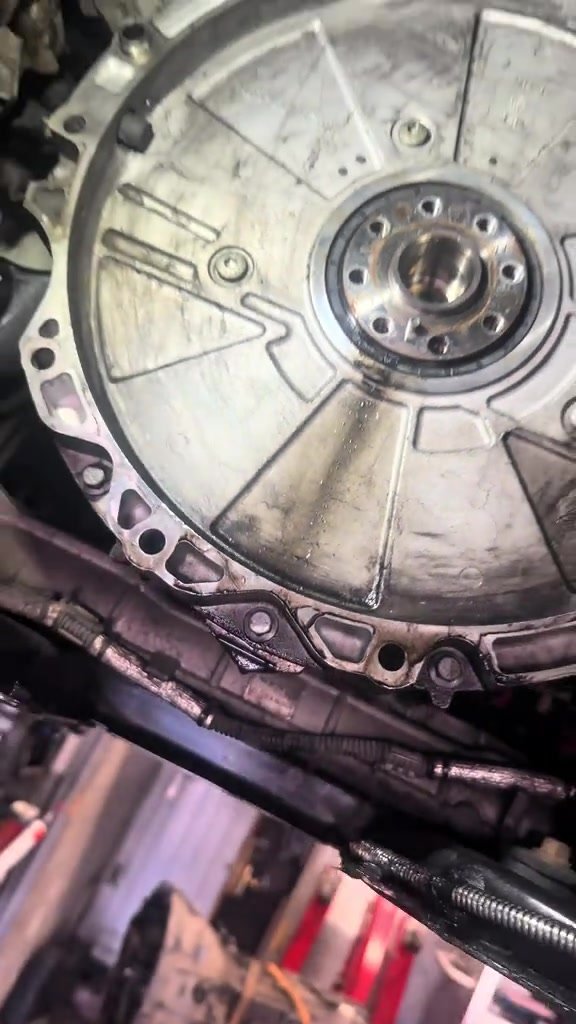
- Remove the flywheel. With the flywheel off, the timing chain casing behind it is exposed.
If that sounds like a lot of the same work as a clutch replacement, it is. On a manual car with a worn clutch, it is worth asking about the clutch while the box is out. Our guide to engine-out and gearbox-out jobs explains why the big access work is where most of the time goes on repairs like this.
Why the Timing Chain Casing Comes Off Too
On many engines, the rear main seal is pressed into a simple carrier and can be prised out once the flywheel is off. On this Jaguar it was different. With the flywheel removed, what is behind it is the timing chain casing, and the seal is fitted into that casing. So the casing had to be unbolted and pulled off the back of the engine.
That adds a step most owners would never guess at, and it brings a practical warning from Dan: even with the oil drained, there is a cavity behind the casing that holds oil. Pull the casing and that oil comes out. Have a drain pan ready and expect a mess. A garage that does not expect it ends up with oil across the floor and, worse, contamination where it should not be.
Timing chains at the gearbox end of the engine are a feature we see on a number of modern Jaguar and Land Rover engines. If you want to understand why those chains wear, our article on Jaguar Ingenium timing chain stretch covers it. For this job, though, the chain was not the issue — the casing simply had to come off to reach the seal.
Fitting the New Seal — and Why We Wait 24 Hours
The new rear main oil seal went into the casing on the bench with a little red rubber grease, so the lip is lubricated as it goes in and is not dragged dry over the crankshaft on first start. A dry lip can tear or fold on fitting, and a seal damaged on day one will leak just like the old one.
The casing then goes back on with silicone sealant. This is where we take a view some garages will not: Dan leaves that silicone 24 hours to set before oil goes back in. Filling and running an engine on fresh sealant is the quickest way to turn a seal repair into a casing leak. Waiting overnight costs the car a day off the road. Rushing it can cost the whole job being done twice.
The next morning:
- The oil goes back in.
- The car is road tested to make sure everything is right.
- After a quick clean down, the undertray goes back on.
- The car goes back to the customer.

Can You Drive With a Rear Main Seal Leak?
A light weep is not an emergency, but it is not something to ignore either. The honest answer depends on how fast it is leaking and where the oil is going.
| What you see | What it usually means | What to do |
|---|---|---|
| Damp, oily film at the bellhousing, oil level steady | An early weep | Check the oil level often and get it diagnosed |
| Spots on the drive, oil needing topping up | An active leak | Book it in soon; keep the level topped up |
| Puddles, burning smell, smoke or clutch problems | A heavy leak or oil reaching where it should not | Stop driving and get it looked at |
The biggest risk is running the engine low on oil. A leak you ignore can starve the engine, and that is far more serious than the seal. If you ever see an oil warning on the dash, read our guide to what an oil pressure warning light means and do not keep driving.
Will an oil leak fail the MOT?
It can. The MOT inspection manual tells testers to fail a car if a fluid leak makes a pool more than 75mm across within five minutes. A leak that is excessive and likely to harm the environment is a major defect, and one that poses a serious risk to road safety is dangerous. Testers can even refuse to carry out the test if a leak is excessive.
Our View: Diagnose First, Then Strip
Most rear main seal guides jump straight to “it is a big job”. What they skip is the step that matters most: making sure it really is the rear main seal before the gearbox comes off. A gearbox-off job to fix a leak that was actually coming from higher up is the worst outcome for everyone.
We trace the oil to its highest point, clean the area and recheck where needed. We applied the same thinking on a Mercedes, which we wrote up in diagnosing oil leaks the right way. Only once the source is confirmed do we agree the repair with you.
Frequently Asked Questions
How do I know if my rear main seal is leaking?
Look for oil where the engine meets the gearbox, drips under the middle of the car, and an oil level that drops between services. Because other leaks can run down to the same spot, a garage should confirm the source before the gearbox is removed.
Can you drive with a rear main seal leak?
With a slow weep you can usually keep driving for a short time while checking the oil level often. A heavy leak, a burning smell or any oil warning light means stop and get it inspected, because running low on oil can damage the engine.
Will a rear main seal leak fail an MOT?
It can. The MOT inspection manual says a car should fail if a fluid leak forms a pool over 75mm across within five minutes. An excessive leak likely to harm the environment is a major defect.
Why does a rear main seal replacement take so long?
Because the seal sits behind the gearbox and flywheel. On this Jaguar the timing chain casing also had to come off, and we left the new silicone 24 hours to cure before refilling with oil and road testing.
Oil Under Your Jaguar?
If you are topping up oil more often than you should be, or there is a drip line from the back of the engine, get it looked at before it gets worse. We will find where the oil is really coming from and explain the repair before any work starts.
Book a Leak Repair With Star Garage Mansfield
From diagnosis to general repairs like rear main seal replacement, we do the whole job in-house. Message us with your registration for a quote.
Call 01623 904724 — Star Garage Mansfield
Need this looked at?
Describe the symptom and we’ll tell you whether it needs a diagnostic slot or a straight booking.
- 5.0 from 235 Google reviews
- Mon–Fri 08:30–18:00
- 2 Warsop Road, Mansfield Woodhouse