If your Peugeot 308, 208, 3008 or RCZ 1.6 THP rattles for a few seconds on a cold start, you are hearing one of the best-known timing chain faults of the last twenty years. The same engine sits in Citroën and DS models, in the MINI Cooper and Cooper S, and in the BMW 116i and 118i. Four badges, one engine, one fault, one repair. This guide explains how to tell whether your car has it and what to do about it.
Quick Answer
Contents
What Is the Prince Engine, and Why Does It Wear Four Badges?
“Prince” is the development codename for a family of 1.4 and 1.6-litre four-cylinder petrol engines designed jointly by BMW and PSA Peugeot Citroën. The partnership was announced in 2002 and the first engines went into production in 2006, with the Peugeot 207 and the second-generation MINI among the first cars to get it. Components were produced by PSA in France, with MINI and BMW engines assembled at Hams Hall in Warwickshire.
Each manufacturer gave the engine its own name, which is why so few owners realise they share a problem:
- Peugeot, Citroën and DS call it the EP6 (1.6) or EP3 (1.4). The turbocharged 1.6 is sold as the 1.6 THP (THP 150, 155, 156, 163, 165, 175, 200 and above); the non-turbo 1.6 is the 1.6 VTi 120.
- MINI calls it the N12, N14, N16 and N18.
- BMW calls the turbocharged version fitted to the 1 Series and 3 Series the N13.
The timing chain and its tensioner were designed by BMW, and a service bulletin was issued in 2013 for failing timing chains and tensioners across the family (recorded in the Prince engine reference). Parts suppliers reflect the same thing: BGA lists one timing chain kit, TC1030VFK, against the Peugeot/Citroën EP3 and EP6, the BMW N13 and the MINI N12 and N18 alike in its Prince engine technical note.
Which Cars Have the Prince Engine? Every Model, by Make
Find your make below. If your car has a 1.6 THP, 1.6 VTi, 1.4 VTi, or one of the MINI and BMW engines listed, it has a Prince engine.
Peugeot
| Model | Prince engine fitted |
|---|---|
| 207 (incl. GT, GTi, RC, CC) | 1.6 THP turbo; 1.6 VTi 120; 1.4 VTi |
| 208 (first generation) and 208 GTi | 1.6 THP turbo, including the GTi; 1.6 VTi 120 and 1.4 VTi (2012–2015) |
| 308 (incl. GT, GTi, CC) | 1.6 THP turbo; 1.6 VTi 120; 1.4 VTi |
| 2008 (2013–2015) | 1.6 VTi 120 |
| 3008 | 1.6 THP turbo; 1.6 VTi 120 (2010–2015) |
| 5008 | 1.6 THP turbo |
| 508 | 1.6 THP turbo; 1.6 VTi 120 (2011–2015) |
| RCZ (2010–2015) | 1.6 THP 156 and 200 turbo; THP 270 in the RCZ R |
Citroën and DS
| Model | Prince engine fitted |
|---|---|
| Citroën C4 (2008 on) | 1.6 THP turbo; 1.6 VTi 120 |
| Citroën C4 Picasso / Grand C4 Picasso | 1.6 THP turbo |
| Citroën C3 and C3 Picasso (2009 on) | 1.6 VTi 120; 1.4 VTi |
| DS 3 (incl. DS3 Racing) | 1.6 THP turbo; 1.6 VTi 120; 1.4 VTi |
| DS 4 | 1.6 THP turbo; 1.6 VTi 120 |
| DS 5 | 1.6 THP turbo |
MINI (second generation, 2006–2016)
| Model | Engine code |
|---|---|
| MINI One and Cooper, 2007–2010 | N12 (non-turbo) |
| MINI Cooper S, 2007–2010 | N14 (turbo) |
| MINI John Cooper Works | N14 or N18 (turbo), depending on year |
| MINI One and Cooper, 2010 on | N16 (non-turbo) |
| MINI Cooper S, 2010 on | N18 (turbo) |
That covers the hatch, Clubman, Convertible, Coupé, Roadster, Countryman (R60) and Paceman (R61). If you drive a MINI, we have a separate MINI N18 timing chain case study showing the fault diagnosed on a Paceman Cooper S before it failed.
BMW (N13, 2011–2016)
| Model | Engine code |
|---|---|
| 1 Series F20/F21: 114i, 116i, 118i, 120i (2015–2016) | N13 1.6 turbo |
| 3 Series F30: 316i, 320i EfficientDynamics | N13 1.6 turbo |
Same Badge, Different Engine: Which 1.6 Peugeots and Citroëns Are Not Prince
A “1.6” badge does not tell you which engine you have. Before you book a Prince timing chain job, check it is actually a Prince engine. These are not:
- The older 1.6 16v petrol (TU5, engine code TU5JP4). Fitted to the Peugeot 206 and 307, early 207s, the first Citroën C4, the C2, C3, Berlingo and Partner. This engine has a timing belt, not a chain, and it is replaced on a mileage and age schedule. It does not have the Prince chain fault.
- The 1.6 HDi and 1.6 BlueHDi diesels. These are a separate PSA-Ford diesel family with a belt-driven camshaft. Different engine, different job.
- The 1.2 PureTech three-cylinder petrol. A newer PSA engine which, in most versions, has a belt running in oil and its own known problems. Not a Prince engine.
- The 1.5 BlueHDi diesel. It has a timing chain, but a different design with a different fault. See our Peugeot 1.5 BlueHDi timing chain guide.
Why the Timing Chain and Tensioner Fail
The tensioner loses pressure when the engine stands
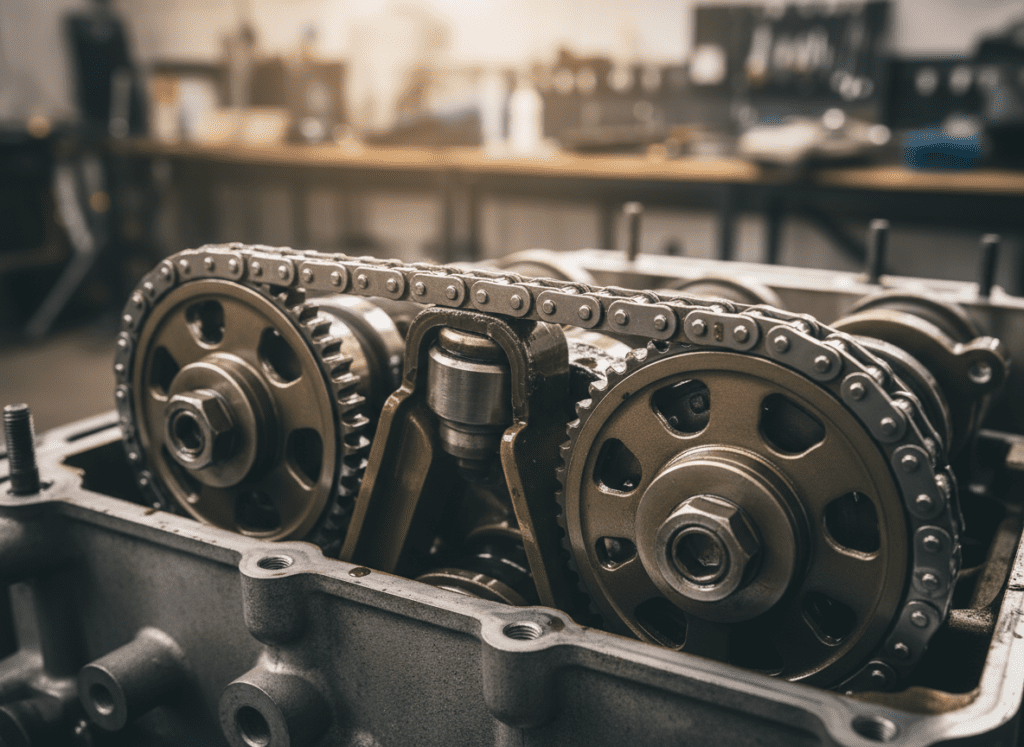
The chain is kept tight by a hydraulic tensioner fed by engine oil. When the car sits overnight the tensioner bleeds down. For the first few seconds after a cold start, before oil pressure builds, the chain runs slack and slaps against its guides. That is the rattle, and each time it happens the chain and guides wear a little more.
The chain stretches
As the chain wears, it lengthens. The tensioner compensates until it reaches the end of its travel. After that the chain cannot be held tight and cam timing starts to drift. BGA’s analysis of the family describes the chain as stretching over time and the tensioner as unable to keep its oil pressure.
Oil condition and oil level
These engines run on low-viscosity oil and are known for burning oil as they age, so a car can be run low between services without the owner knowing. Low or tired oil means a slower, weaker tensioner. Long service intervals and short journeys, where the oil never gets fully warm, make it worse. Of everything on this list, oil is what you can control.
Guides and the rest of the timing system
The plastic chain guides harden and wear with heat and mileage. On high-mileage engines the variable valve timing (VANOS) unit on the camshaft can wear as well, which is why a proper repair looks at the whole system, not only the chain.
Symptoms, in the Order They Usually Appear
1. A rattle for a few seconds on a cold start
The first and most reliable sign. A metallic rattle or chain slap straight after starting from cold, typically after the car has stood overnight, fading as oil pressure builds. MINI owners call it the “death rattle”, and a 1.6 THP makes exactly the same sound.
2. The rattle lasts longer, or comes back when warm
As the chain stretches, the noise lasts longer after start-up. Eventually it can be heard at idle when warm, or when the engine is labouring at low revs.
3. Engine management light
The engine control unit compares crankshaft and camshaft positions. When chain stretch moves the cam timing outside tolerance, it logs a fault and lights the dash.
4. Rough idle, hesitation and poor cold running
Drifting cam timing upsets how the engine runs. Expect sluggish acceleration from cold, occasional misfires and an uneven idle. Owners often blame spark plugs or coils first.
5. Loss of power or limp mode
At the later stages the engine can go into a reduced-power mode. By then the chain is well past the point where it should have been replaced.
Fault Codes Linked to Prince Timing Chain Wear
- P0016 — crankshaft / camshaft position correlation, bank 1 sensor A (intake). The classic chain stretch code on these engines.
- P0017 — the same correlation fault against the exhaust camshaft.
- P0014 / P0015 — exhaust camshaft timing over-advanced or over-retarded.
- P0011 / P0012 — intake camshaft timing over-advanced or over-retarded.
What Happens If You Ignore It
A stretched chain that is left long enough can jump a tooth on the sprocket. The Prince is an interference engine, so once timing is lost the valves can hit the pistons. That turns a planned chain, guide and tensioner job into bent valves, a damaged cylinder head or a replacement engine. On an older 308 or 3008, that bill can be more than the car is worth.
A rattle on cold start is the engine telling you, early, that the chain is wearing. It is the cheapest point at which to act.
What the Repair Involves
Whether the badge on the front says Peugeot, Citroën, DS, MINI or BMW, the job is the same. At Star Garage Mansfield our approach is:
- Diagnose first. We read the fault codes, check live camshaft and crankshaft correlation data and confirm the noise is the chain rather than a VANOS unit, a high-pressure fuel pump or an ancillary.
- Replace the whole kit, not just the tensioner. Chain, guides, tensioner and the relevant sprockets go together, using the updated components. A new tensioner on a stretched chain only postpones the failure.
- Set the timing with the correct locking tools. The Prince engine has no timing marks to eyeball. It is timed using dedicated crank and camshaft locking tools.
- Check what else the strip-down shows. The condition of the VANOS unit, oil level history and any guide debris all tell us whether anything else needs attention.
- Fresh oil, then a road test from cold and under load before the car goes back.
The cost depends on the variant and on what the strip-down finds, so it is priced on inspection. See our timing chain and belt service for how we work, or our general guide to timing chain problems and symptoms.
1.6 THP or MINI Rattling on Cold Start?
Get it checked before the chain jumps. A diagnostic at Star Garage Mansfield tells you exactly what state the chain is in and whether the car is safe to drive while you plan the repair.
Call 01623 904724 — Star Garage Mansfield, 2 Warsop Road, NG19 9LF
Frequently Asked Questions
Is the Peugeot 1.6 THP the same engine as the MINI Cooper S?
Yes. The 1.6 THP is the turbocharged Prince engine, developed jointly by BMW and PSA. MINI calls it the N14 and N18, and BMW calls it the N13. The timing chain, tensioner and repair are the same.
Does the Peugeot 308 1.6 have a timing chain or a timing belt?
The 1.6 THP and 1.6 VTi in the 308 have a timing chain. The older 1.6 16v petrol and the 1.6 HDi diesel have timing belts. Check the engine code on your paperwork if you are not sure.
What cars use the Prince engine?
Peugeot 207, 208, 308, 2008, 3008, 5008, 508 and RCZ; Citroën C3, C4 and C4 Picasso; DS 3, DS 4 and DS 5; the second-generation MINI range; and the BMW 114i, 116i, 118i, 120i, 316i and 320i ED.
Can I keep driving with a cold start rattle?
Only gently and only until you can get it booked in. Keep journeys short, keep the oil level topped up and avoid hard acceleration. Each cold start adds wear, and if the chain jumps the damage is severe.
How long does a 1.6 THP timing chain last?
There is no fixed replacement interval. It depends mainly on oil level, oil quality and how often the engine starts from cold. Some last a long time and others rattle early. The noise, not the mileage, tells you when it needs attention.
Is it just the tensioner I need?
Almost never on its own. By the time the tensioner rattles, the chain has usually stretched. We replace chain, guides and tensioner together so the repair lasts.
Does the BMW 116i or 118i have the same timing chain problem?
The F20 116i and 118i built between 2011 and 2015 use the N13 version of the Prince engine and can have the same chain and tensioner fault. Later 116i and 118i models moved to the three-cylinder B38 engine, which is a different design.
Need this looked at?
Describe the symptom and we’ll tell you whether it needs a diagnostic slot or a straight booking.
- 5.0 from 235 Google reviews
- Mon–Fri 08:30–18:00
- 2 Warsop Road, Mansfield Woodhouse