
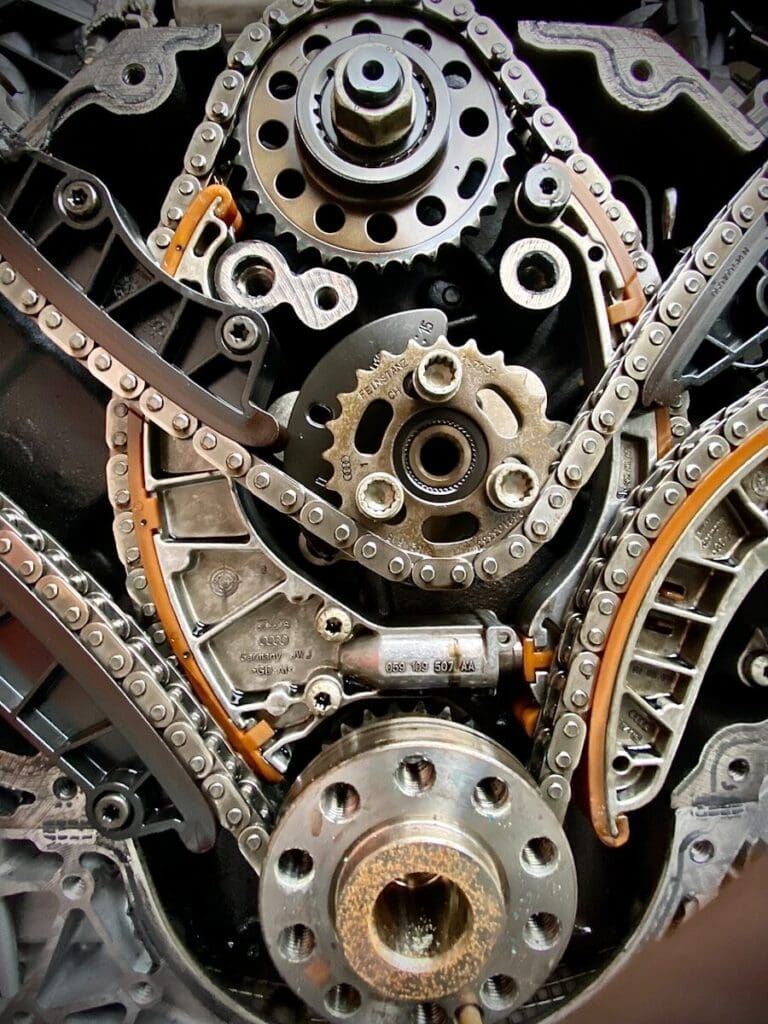
Timing chain problems are one of the most common major engine issues we see at Star Garage Mansfield.
They rarely fail without warning.
They almost always start with noise, hesitation, or subtle running changes.
The issue is not that drivers ignore symptoms.
It is that many are told a timing chain is “lifetime” and therefore safe.
In modern engines, that assumption is often wrong.
This pillar guide explains:
- What timing chain problems actually are
- The early symptoms most drivers miss
- Why modern engines are more vulnerable
- How failures escalate
- What actually drives the cost of a repair
- When to book diagnostics
- What a timing chain does
- Why timing chain problems are increasing
- Early symptoms drivers overlook
- Cold start rattle explained
- Fault codes and warning lights
- What happens if the chain jumps timing
- What drives the cost of a repair
- How we diagnose timing chain issues
Startup Rattle? Do Not Wait for a Warning Light
A metallic rattle for 1–3 seconds when starting from cold is often the first stage of timing chain wear.
Related reading: our Jaguar Ingenium 2.0 timing chain replacement cost breakdown and common Ingenium 2.0 engine problems.
Many serious failures begin months before a dashboard light appears.
If your engine sounds different, book a diagnostic inspection early. The cost difference between early intervention and full engine rebuild is significant.
What Does a Timing Chain Actually Do?
The timing chain synchronises the crankshaft and camshaft.
That synchronisation controls:
- Valve opening and closing
- Fuel injection timing
- Compression balance
- Combustion efficiency
If timing shifts even slightly, the engine no longer operates in its designed window.
Unlike timing belts, chains:
- Run inside the engine
- Are lubricated by oil
- Use hydraulic tensioners
- Rely entirely on oil pressure
That last point is critical.
Why Timing Chain Problems Are Increasing
Modern engines operate under tighter tolerances than older units.
- Higher compression
- Turbocharging
- Longer oil change intervals
- Reduced friction components
Chains are lighter.
Guides are thinner.
Tensioners are more sensitive to oil condition.
Combine that with 18,000+ mile service intervals and degraded oil, and wear accelerates.
We regularly see failures in:
- BMW N47 engines
- 1.6 CDTi Vauxhall/Opel units
- Jaguar and Land Rover Ingenium diesels
- Small turbo petrol engines with rear-mounted chains
Early Timing Chain Symptoms Most Drivers Miss
1. Brief Metallic Rattle on Startup
This is the most common early sign.
It usually lasts 1–5 seconds.
It disappears once oil pressure builds.
That does not mean it is harmless.
2. Slight Hesitation Under Load
Minor cam timing shift affects combustion efficiency.
Drivers describe it as “not quite as sharp as it used to be”.
3. Intermittent Engine Management Light
Correlation faults may appear and clear.
4. Rough Idle When Cold
Valve timing instability causes uneven running.
5. Ticking That Gradually Gets Louder
As guides wear, noise increases over months.
Cold Start Rattle Explained
When an engine sits overnight:
- Oil drains back into the sump
- Tensioners lose pressure
- Clearances widen
If the chain is worn, slack appears immediately on startup.
The chain slaps against guides until oil pressure builds.
Each cold start accelerates wear.
This is why we advise investigation early rather than waiting for failure.
Fault Codes Linked to Timing Chain Problems
Common diagnostic codes include:
- Camshaft/crankshaft correlation faults
- Variable timing actuator faults
- Misfire codes linked to timing drift
However, chains can stretch significantly before codes appear.
Mechanical wear often precedes electronic warning.
What Happens If the Timing Chain Jumps?
If stretch becomes severe or a guide breaks:
- The chain can jump teeth
- Valve timing shifts suddenly
- Pistons may strike valves
- Compression is lost instantly
In interference engines, this means bent valves and possible piston damage.
At that point, repair escalates dramatically.
What Drives the Cost of a Timing Chain Repair
Two cars with the same fault rarely cost the same to fix. The figure comes down to a handful of things we can only confirm once the engine is in front of us:
- Where the chain sits. A front-mounted chain is reachable with the engine in the car. A rear-mounted chain usually means the engine or gearbox comes out, and that is labour before a single part is fitted.
- How much of the kit needs replacing. Guides, tensioner and sprockets are routinely renewed alongside the chain. On some engines the oil pump chain is driven off the same assembly and has to go with it.
- Whether the timing has already jumped. A stretched chain caught early is a mechanical job. A chain that has skipped teeth in an interference engine can mean bent valves, and the work becomes a head-off or rebuild.
- Oil condition and secondary wear. Sludge that wore the chain has usually been through the rest of the engine too, and that can add work we only find on strip-down.
- Parts supply on the day. Component prices move constantly and suppliers cannot always get the same parts week to week.
That last point is why we price on the day rather than publish a figure. A number quoted months ago is worthless by the time you ring us, and we would rather give you an honest cost against your car than a headline that changes. The single biggest lever on the final bill is how early you get it looked at — the gap between an early inspection and a post-failure rebuild is enormous.
Why Oil Quality Matters
Timing chains rely on clean, correctly specified oil.
Extended intervals lead to:
- Sludge buildup
- Tensioner starvation
- Guide wear
- Chain elongation
We recommend shorter service intervals on high-risk engines.
Our Diagnostic Approach at Star Garage Mansfield
We do not rely solely on fault codes.
Our process includes:
- Cold start listening tests
- Live cam/crank data analysis
- Oil condition inspection
- Mechanical inspection where required
- Clear explanation before repair
You receive evidence, not guesswork.
Concerned About Timing Chain Problems?
If your engine is rattling, hesitating, or showing timing-related faults, do not wait.
View timing chain services
Book diagnostics in Mansfield
Speak to our team
Call 01623 904724
Star Garage Mansfield, NG19 9LF
Frequently Asked Questions
How long should a timing chain last?
Some exceed 150,000 miles. Others fail before 80,000. Design and maintenance history matter more than mileage alone.
Is a timing chain better than a belt?
Not always. Chains can last longer, but when they fail, repairs are often more expensive.
Can I drive with timing chain noise?
You may be able to short-term, but risk increases daily. Sudden failure is possible.
Will changing oil fix timing chain problems?
Fresh oil helps prevent wear but cannot reverse existing chain stretch.
Does a warning light always appear?
No. Noise often appears before fault codes.
Audi 2.0 TFSI engines have a well-documented tensioner failure pattern — our Audi timing chain problems guide covers the specific fault codes, symptoms, and repair costs for that engine family.
Need this looked at?
Describe the symptom and we’ll tell you whether it needs a diagnostic slot or a straight booking.
- 5.0 from 235 Google reviews
- Mon–Fri 08:30–18:00
- 2 Warsop Road, Mansfield Woodhouse